Louisa Botten*
Dogs play a significant role in many of our lives, and, for many, our pets are often spoiled with all kinds of toys and accessories. Even the Supreme Court is just as obsessed with pets and silly toys as we are. The Court has granted certiorari to the “Bad Spaniels” case, where a company created and sold a dog toy that resembles Jack Daniel’s Tennessee Sour Mash Whiskey.[1] All jokes aside, this Supreme Court decision could seriously affect the scope of protection afforded to trademark holders. While we wait for the Supreme Court’s decision, which is anticipated before the summer recess, here is a summary of the key legal issues and a breakdown of the procedural posture of the case.[2]
I. Trademark Law Basics
Before we jump in, it is important to learn some of the basics of trademark law. Trademark protection is a question of both federal law, under the Lanham Act,[3] and state laws.[4] In order for a mark to be protected under trademark law, the mark must be used in commerce, distinguish the source of the goods or services,[5] and must not be functional.[6] While one need not register their mark on the Principal Register, a registration creates a presumption of validity.[7]
Trademark infringement occurs when the offending use of the mark or a similar mark is likely to cause consumer confusion.[8] Courts find likelihood of confusion by weighing many factors, such as the strength of the original mark, the proximity of the goods, the similarity of the marks, and the degree of care likely to be exercised by the purchaser of the goods.[9]
A trademark holder can also protect their mark by bringing a dilution claim. Dilution can occur through blurring, where the mark’s power to identify the mark holder’s good is impaired, or through tarnishment, where the offending use creates an unpleasant association with the mark holder’s good or brand.[10]
There is an exception to trademark infringement for expressive works. In the case where the offending use of the mark is part of an expressive work, the Rogers test only grants the trademark holder a claim for infringement if the trademark is (1) “not artistically relevant to the [underlying] work or (2) explicitly misleads consumers as to the source or the content of the work.”[11] First, the defendant has the burden of establishing their use of the mark as part of an expressive work.[12] Then, the plaintiff must establish that either one of these two factors is present.[13] If the plaintiff is able to do so, then the court must a conduct an analysis of likelihood of confusion.[14]
II. Present Case
Now, to discuss the present case. The offending toy comes from VIP’s “Silly Squeakers” line, which “includes a variety of toys in the shapes of beer, wine, soda, and liquor bottles.”[15] Specifically,
[t]he “Bad Spaniels” toy is in the shape of a liquor bottle and features a wide-eyed spaniel over the words “Bad Spaniels[,]” “the Old No. 2, on your Tennessee Carpet.” At the bottom of the “Bad Spaniels” toy, it reads: “43% POO BY VOL.” and “100% SMELLY[.]” On the back of the Silly Squeakers label for the “Bad Spaniels” toy, it states: “This product is not affiliated with Jack Daniel Distillery.”[16]
Jack Daniel’s, who has a registered trademark and trade dress, demanded that VIP stop selling the product.[17] VIP then filed “a complaint seeking a declaratory judgment that ‘Bad Spaniels’ did not infringe or dilute any trademark or trade dress rights owned by Jack Daniel’s.”[18]
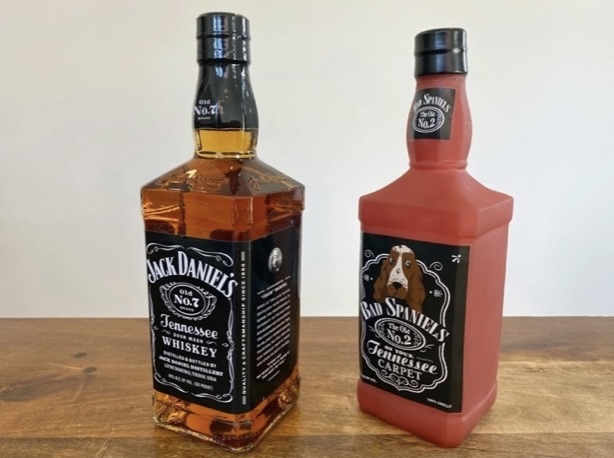
On the left, Jack Daniel’s product, and on the right, VIP’s dog toy.[19]
After the court heard both parties’ motions for summary judgment, the court held a bench trial to determine whether the toy infringed on Jack Daniel’s copyright and tarnished their mark.[20] The district court ruled in favor of the defendant, granting permanent injunctive relief.[21] The court found that VIP’s toy tarnished Jack Daniel’s copyright and caused consumer confusion.[22] Additionally, the court rejected VIP’s claim of parody, as they deemed “the purpose of the similarity [between the two brands was] to capitalize on [Jack Daniel’s] popularity for [VIP’s] own commercial gain,” rather than as some sort of commentary on Jack Daniel’s.[23]
VIP appealed the district court’s judgment, and the Ninth Circuit Court of Appeals vacated the district court’s judgment regarding trademark infringement and reversed the judgment on dilution.[24] The Court of Appeals focused much of their decision on the First Amendment.[25] When analyzing likelihood of confusion, the court applied the Rogers test.[26] First, the court looked at whether the dog toy is an expressive work by determining whether it was “communicating ideas or expressing points of view.”[27] The court concluded that “although surely not the equivalent of the Mona Lisa, [the toy] is an expressive work.”[28] The Court of Appeals remanded for a determination of whether Jack Daniel’s can satisfy one of the elements of the Rogers test, which is required to find a showing of infringement.[29] Regarding the dilution claim, the court did not analyze a First Amendment defense but instead relied upon statutory defenses.[30] The court reasoned that in order for tarnishment to occur, the speech must be commercial.[31] As the Bad Spaniels toy used Jack Daniel’s mark to “convey a humorous message,” it is noncommercial and thus falls into one of the defenses to a dilution claim.[32]
On a determination of “whether [Jack Daniel’s] can satisfy the Rogers test to defeat VIP’s First Amendment argument, and [if necessary,] reapplication of the likelihood-of-confusion test if [Jack Daniel’s] succeeds,”[33] the district court found “that summary judgment should be entered in favor of VIP on [Jack Daniel’s] claim for trademark infringement.”[34] Concerning the first element of the Rogers test, the court found that Jack Daniel’s mark was artistically relevant to the toy, despite not seeming to be any commentary upon the company or the product.[35] Regarding the second element of the Rogers test, the court determined that the use must “be an explicit indication, overt claim, or explicit misstatement about the source of the work.”[36] As the Bad Spaniels toy adds expressive content to the Jack Daniels mark, “identifies itself as a Silly Squeaker toy on the label, and. . . disclaims any association with Jack Daniel’s,”[37] the “toy is not explicitly misleading.”[38]
Upon conclusion of their opinion, the District Court offered some commentary on the Rogers test and the protection (or lack thereof) the test affords to trademark holders:
[I]t appears nearly impossible for any trademark holder to prevail under the Rogers test. Where relevance need be merely “above zero” – which is to say, relevance can be scant or de minimis – it is difficult to imagine what creative junior use would not pass the Rogers test. . . . Similarly, the “explicitly misleading” standard essentially displaces the likelihood-of-confusion test with a standard that excuses nearly any use less than slapping another’s trademark on your own work and calling it your own. . . . For [Jack Daniel’s] or similarly situated trademark holders to obtain a different outcome, they must seek relief before the United States Supreme Court or the United States Congress.[39]
Following this opinion, the Court of Appeals affirmed the District Court’s judgment and the Supreme Court granted certiorari.[40]As of now it seems that our dogs can still enjoy their toys, but stay tuned for an update on the case when the Supreme Court issues their decision!
* Louisa Botten, J.D. Candidate, University of St. Thomas School of Law Class of 2024, Associate Editor.
[1] VIP Prods. LLC v. Jack Daniel’s Props., Inc., No. 21-16969, 2022 U.S. App. LEXIS 14657 (9th Cir. Mar. 18, 2022), cert. granted 143 S. Ct. 476 (Nov. 21, 2022); see VIP Prods. LLC v. Jack Daniel’s Props., 953 F.3d 1170, 1172 (9th Cir. 2020).
[2] See Adam Liptak, May ‘Bad Spaniels’ Mock Jack Daniel’s? The Supreme Court Will Decide., N.Y. Times: Sidebar (Dec. 5, 2022), https://www.nytimes.com/2022/12/05/us/politics/bad-spaniels-jack-daniels-dog-toy.html.
[3] Lanham (Trademark) Act, 15 U.S.C. §§ 1051-1141n.
[4] See John T. Cross, The Role of the States in United States Trademark Law, 49 U. Louisville L. Rev. 485, 487 (2011).
[5] 15 U.S.C. § 1127.
[6] See Qualitex Co. v. Jacobson Prods. Co., 514 U.S. 159, 164 (1995).
[7] 15 U.S.C. § 1115.
[8] AMF, Inc. v. Sleekcraft Boats, 599 F.2d 341, 348 (9th Cir. 1979).
[9] Id. at 348–49.
[10] 15 U.S.C. § 1125(C).
[11] Gordon v. Drape Creative, Inc., 909 F.3d 257, 264 (9th Cir. 2018) (citing to Rogers v. Grimaldi, 875 F.2d 994, 999 (2d Cir. 1989)).
[12] Id. at 264.
[13] Id.
[14] Id. at 265.
[15] VIP Prods., LLC v. Jack Daniel’s Props., 291 F. Supp. 3d 891, 898 (D. Ariz. 2018).
[16] Id. (citation omitted).
[17] Id. at 898–899.
[18] Id. at 899.
[19] Photograph of Jack Daniel’s Whiskey and VIP’s dog toy, in Adam Liptak, May ‘Bad Spaniels’ Mock Jack Daniel’s? The Supreme Court Will Decide., N.Y. Times: Sidebar (Dec. 5, 2022), https://www.nytimes.com/2022/12/05/us/politics/bad-spaniels-jack-daniels-dog-toy.html.
[20] VIP Prods., LLC, 291 F. Supp. 3d at 897.
[21] Id.
[22] Id. at 905, 911.
[23] Id. at 908.
[24] VIP Prods. LLC v. Jack Daniel’s Props., 953 F.3d 1170, 1172 (9th Cir. 2020).
[25] Id. at 1174–1176.
[26] Id. at 1174.
[27] Id. at 1174–1175 (quoting L.L. Bean, Inc. v. Drake Publishers, Inc., 811 F.2d 26, 29 (1st Cir. 1987)).
[28] Id. at 1175.
[29] Id. at 1176.
[30] Id. at 1176; 15 U.S.C. § 1125 (C)(3)(C).
[31] VIP Prods. LLC., 953 F.3d at 1176.
[32] Id.; 15 U.S.C. § 1125 (C)(3)(C) (“Any noncommercial use of a mark” is not “actionable as dilution by blurring or dilution by tarnishment”).
[33] VIP Prods. LLC v. Jack Daniel’s Props., No. CV-14-02057-PHX-SMM, 2021 U.S. Dist. LEXIS 232410, at *7 (D. Ariz. Oct. 8, 2021).
[34] Id. at *8–9.
[35] Id. at *11–14.
[36] Id. at *14 (citing Dr. Seuss Enters. v. ComicMix LLC, 983 F.3d 443, 462 (9th Cir. 2020)).
[37] Id. at *18.
[38] Id.
[39] Id. at *18–20.
[40] VIP Prods. LLC v. Jack Daniel’s Props., Inc., No. 21-16969, 2022 U.S. App. LEXIS 14657 (9th Cir. Mar. 18, 2022), cert. granted 143 S. Ct. 476 (Nov. 21, 2022).
 University of St. Thomas Law Journal
Leave a comment