by Micayla Bitz*
As he prepared to welcome the first class of law students to the University of St. Thomas, Patrick Schiltz worked with his office door propped open. He was listening for the sound of squeaky wheels—the University’s mail cart announcing its arrival.1
It was the summer of 2000, and “[a]lthough the law school was scheduled to open in a little more than a year, almost nothing had been done.”2 As the school’s founding Associate Dean, Schiltz was responsible for nearly all the administrative tasks, including drafting the application.
And then came the waiting. Once Schiltz heard the familiar squeak of the mail cart each morning, he would rush down to the Admissions Office—longing for an overflowing stack of applications.
“There were days we had zero applications,” Schiltz, now the Chief Judge of the United States District Court for the District of Minnesota, recalled. “It was just crushing.”3 Those sparse mail days cast a shadow of doubt over Schiltz’s vision. “There were a lot of anxious moments,” he said. “What do you do if nobody applies to your law school?”4
But as the first day of classes neared, the applications increased both in number and in quality. By August of 2001, the law school had commitments from 120 students—nearly fifty percent more than Schiltz’s initial goal of eighty to eighty-five.5
“I remember when all 120 people showed up that day,” Schiltz reminisced. “It was such a great atmosphere. That was the happiest day—the day they all showed up.”6
From Reckoning Came Rebirth
Just a few years before Schiltz found himself building a law school from the ground up, he was a partner at one of the largest law firms in Minneapolis and celebrating a judgment of over $5 billion in the Exxon Valdez oil spill litigation.7 Once collected, “even the smallest partner’s share [of the judgment] would be a few hundred thousand dollars.”8 But Schiltz and his wife,9 a partner at the same firm, decided to leave the Exxon money and big firm life behind in exchange for teaching positions at Notre Dame Law School.10
“I came to a point in my legal career where I was pursuing things different than my values,” Schiltz said.11 “I went to law school intending to do one thing with my legal education, and then I ended up being a partner at a big firm and reluctant to leave for reasons that would not have been important to me ten years earlier when I started law school.”12
After teaching at Notre Dame Law School for a few years, Schiltz made yet another unconventional choice; he accepted a position as Associate Dean of a law school that did not yet exist.13 Even though Schiltz was adamant that the world did not need another law school, he saw a need for a Catholic law school—a law school that cares about and believes in something “even when doing so—especially when doing so—will put it at odds with society.”14
Schiltz’s personal reckoning with his own values and career choices crystallized his dedication to creating a distinctive mission for St. Thomas. He recognized “the dominant culture of the legal profession—a culture of greed, a culture of materialism” that “pushes in on students from all sides.”15 A Catholic law school could push back. A Catholic law school could be a place where students could integrate their religious or secular values “into their legal identities, rather than replace them with something else.”16
Embracing the Unconventional
The founding faculty at St. Thomas recognized that “staying true to our mission requires that we sometimes make unconventional choices.”17 For this reason, unconventionality became a focal point for many early decisions at the law school: “If you just make the same choices as everybody else,” Schiltz said, “then you haven’t created a distinctive mission.”18
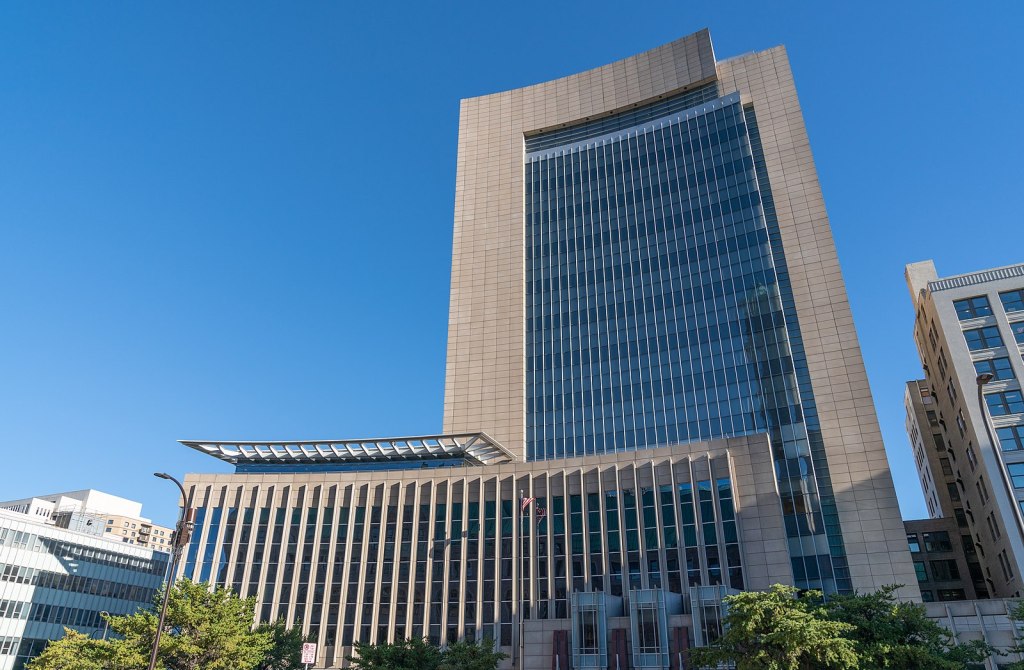
That said, this goal may have been taken too literally by Father David Link, the school’s founding Dean. During a meeting with the architects designing the law school building, Schiltz said Link “basically said that we had been doing a very bad job because we were just building a ‘conventional’ building, and we needed to think outside the box.”19
Link came to the meeting armed with several ideas for an “unconventional” building, including construction of a swimming pool in the atrium.20 “He thought we could put some beach furniture around it so students could just go sit or maybe take a quick dip when they had time between classes,” Schiltz laughed.21
Rather than a conventional law library, Link also suggested housing books in classrooms “so that, when a professor is trying to teach a civil procedure class, people would just walk in if they needed a book in there.”22 While Schiltz noted that this idea would be unconventional, “it would be unconventional for a reason.”23
Then, there was Schiltz’s favorite design idea from Link—an idea Link was “really, really stuck on”: building the Dean’s Suite across the fourth-floor atrium windows with glass floors.24 Although, a glass office could ensure transparency from administration, Schiltz said “it would be like a hamster cage where you could just watch the Dean and his staff working all the time.”25
An Evolving Mission
Twenty-two years later, the law school’s building may be slightly more conventional than Dean Link dreamed, but the unconventional mission to integrate faith and reason, foster moral principles, and champion social justice has not just endured—it has evolved.
As an example, in the inaugural post for the University of St. Thomas Law Journal Blog, the then-Editor-in-Chief and Managing Editor described both the law school and themselves as “statistical long-shots”:26
Since its humble beginnings, the law school has grown from a “long-shot” to now providing a community for other statistical long-shots. It was through the University’s investment in its students that the St. Thomas Law Journal is now led by two students who embody the stories of those who “traditionally” would have struggled to attend law school.27
I shared the Journal students’ post with Schiltz, who expressed how gratifying it was “to read about how they are finding that connection with St. Thomas.”28 He said, “One of the things we really wanted for St. Thomas is that it be more inclusive than secular schools.”29
Over the years, Schiltz has met many students who share the same or a similar story to those Journal students: they all have “something unconventional about their backgrounds, and they find community at St. Thomas.”30
Achieving the Mission
In a speech he gave back when the University of St. Thomas School of Law was still just an idea, Schiltz suggested that the greatest measure of St. Thomas’s success will be “whether its graduates behave differently.”31 But he cautioned that “it will be many years before we know whether, at least on this score, we have been successful.”32
Now that two decades have passed, I asked Schiltz if he believes St. Thomas students and graduates behave differently. With the caveat that his conclusion is “purely anecdotal,” Schiltz said it looks to him like it is working. “They just seem very thoughtful in the way they make their choices, and very intent in making sure that the professional choices they make reflect their personal values,” Schiltz said. “They are just really thoughtful people.”33
* Micayla Bitz, J.D. Candidate, University of St. Thomas School of Law Class of 2024, Editor-in-Chief of the University of St. Thomas Law Journal.
1 Interview with Patrick J. Schiltz, C.J., U.S. Dist. Ct. for the Dist. of Minn., in Minneapolis, Minn. (Mar. 10, 2023) (transcript on file with author).
2 Patrick J. Schiltz, Commemoration of the Fifth Anniversary of the Decision to Open the University of St. Thomas School of Law, 1 U. St. Thomas L.J. 1041, 1048 (2004) [hereinafter Schiltz, Commemoration].
3 Interview with Patrick J. Schiltz, supra note 1.
4 Interview with Patrick J. Schiltz, supra note 1.
5 Interview with Patrick J. Schiltz, supra note 1.
6 Interview with Patrick J. Schiltz, supra note 1.
7 Patrick J. Schiltz, On Being a Happy, Healthy, and Ethical Member of an Unhappy, Unhealthy, and Unethical Profession, 52 Vand. L. Rev. 871, 950–51 (1999) [hereinafter Schiltz, On Being a Happy, Healthy, and Ethical Member].
8 Patrick J. Schiltz, On Being a Happy, Healthy, and Ethical Member of an Unhappy, Unhealthy, and Unethical Profession, 52 Vand. L. Rev. 871, 950–51 (1999) [hereinafter Schiltz, On Being a Happy, Healthy, and Ethical Member].
9 Elizabeth Schiltz was also a founding faculty member at the University of St. Thomas School of Law. Currently, she serves as the school’s Associate Dean of Academic Affairs.
10 Id. at 951.
11 Interview with Patrick J. Schiltz, supra note 1.
12 Interview with Patrick J. Schiltz, supra note 1.
13 Schiltz, Commemoration, supra note 3 at 1042.
14 Schiltz, Commemoration, supra note 3 at 1042–44 (reprinting Schiltz’s remarks at the Red Mass at the University of St. Thomas on September 26, 1999).
15 Schiltz, Commemoration, supra note 3 at 1045.
16 Interview with Patrick J. Schiltz, supra note 1.
17 Schiltz, Commemoration, supra note 3 at 1053.
18 Interview with Patrick J. Schiltz, supra note 1.
19 Interview with Patrick J. Schiltz, supra note 1.
20 Interview with Patrick J. Schiltz, supra note 1.
21 Interview with Patrick J. Schiltz, supra note 1.
22 Interview with Patrick J. Schiltz, supra note 1.
23 Interview with Patrick J. Schiltz, supra note 1.
24 Interview with Patrick J. Schiltz, supra note 1.
25 Interview with Patrick J. Schiltz, supra note 1.
26 Sean Smallwood & Robert Rohloff, Statistical Long-Shots, Univ. St. Thomas L.J. Blog (Nov. 15, 2022), https://ustlawjournal.com/2022/11/15/statistical-long-shots/.
27 Id.
28 Interview with Patrick J. Schiltz, supra note 1.
29 Interview with Patrick J. Schiltz, supra note 1.
30 Interview with Patrick J. Schiltz, supra note 1.
31 Schiltz, Commemoration, supra note 3 at 1043 (reprinting Schiltz’s remarks at the Red Mass on September 26, 1999, at the University of St. Thomas); see also id. at 1041 n.1. (“The ‘Red Mass’ is celebrated in the fall by judges, lawyers, law professors, and public officials, who together pray that the Holy Spirit will guide the legal profession.”).
32 Schiltz, Commemoration, supra note 3 at 1053.
33 Interview with Patrick J. Schiltz, supra note 1.
 University of St. Thomas Law Journal
Leave a comment