Alena Stankaitis*
Picture the word “lawyer” in your mind. What image accompanies this term? Is it a white man in a suit carrying a leather briefcase? This assumption would be statistically correct. In its 2023 report, the American Bar Association surveyed that 73% of all lawyers were white1 and 61% of all lawyers were men.2 “White lawyers are still overrepresented in the legal profession compared with their presence in the U.S. population,” writes the American Bar Association, “but that is slowly changing.”3
Now think about what that lawyer was wearing. Presumably he was donning a well-tailored black or navy suit, clean shaven, and sporting a cropped hairstyle. Like the slow demographic shift in the legal field, these appearance professionalism standards are also changing. In fact, professionalism standards are evolving across industries as Millennials and Generation Z redefine the workplace.4 Why are these standards changing, and is there any reason for them to? This blog explores how the legal field’s physical professionalism standards reinforce harmful Eurocentric beauty standards and gender binaries. This blog advocates for redefining physical notions of professionalism in the legal field, and it provides literature with solutions to counteract the issues raised.

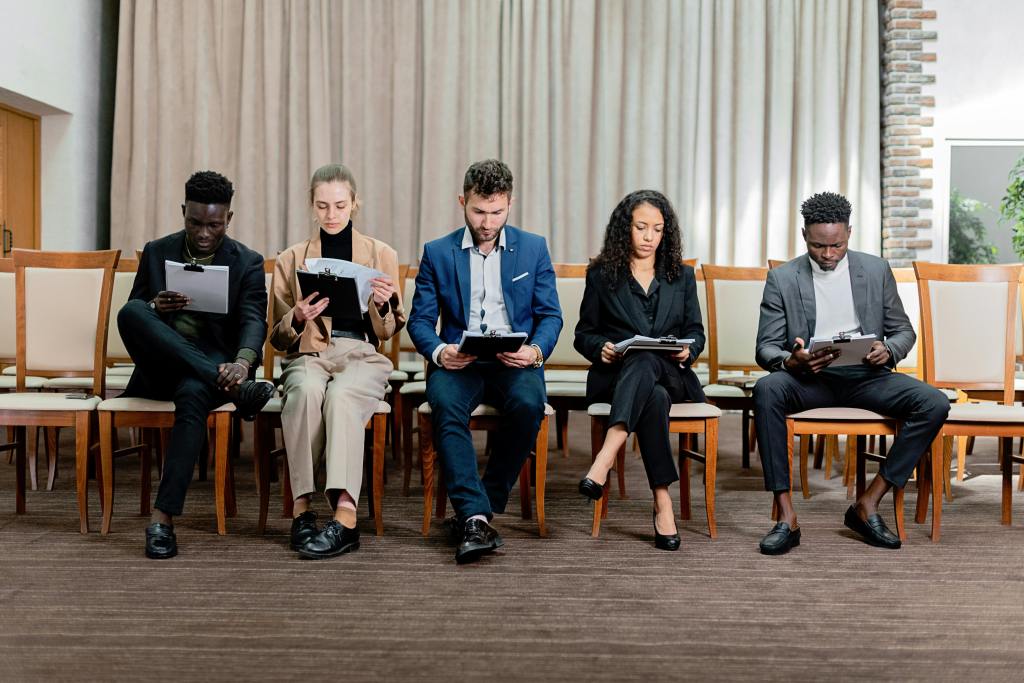
Source: itchaznong, Photograph of an Attorney at Work, in ADOBE STOCK, https://stock.adobe.com/images/close-up-lawyer-businessman-working-or-reading-lawbook-in-office-workplace-for-consultant-lawyer-concept/208190412?asset_id=203206616.
- The Harm on Cisgender Men and Women.
To assimilate in the legal field, lawyers need to look “appropriate and nonthreatening while not distracting from the case.”5 Patricia Fersch, contributor at Forbes, shares, “I was told in my last year of law school by someone who came in to teach us how to dress as lawyers (both men and women) that navy blue was the color of truth. I want to appear like a truth teller.”6 Despite this seemingly innocuous advice to wear a navy suit, this enduring convention hinders crucial tasks that could benefit from attorneys’ time more effectively. This harm is best demonstrated through an anecdote on the periphery of the legal field—involving a Harvard Law School graduate—on the national stage.
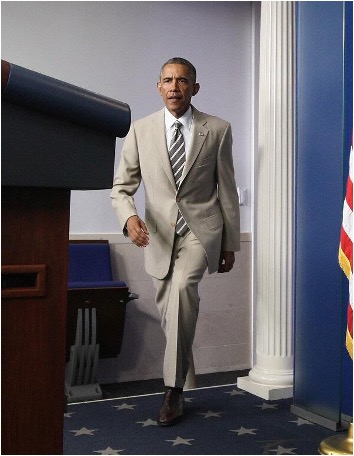
Source: Alex Wong, Photograph of Former President Barack Obama Wearing a Tan Suit, GETTY IMAGES, in James Cave, 10 Years of Barack Obama’s Style of Evolution, HUFFPOST (Dec. 1, 2015, 8:53 AM), https://www.huffpost.com/entry/barack-obama-style_n_565cb68ce4b079b2818b5170.
Former President Barack Obama’s “tan suit controversy” is a textbook example of how the simplest professionalism standards impact cisgender7 men (albeit there are also race-related reasons which are addressed in Section II). After he walked into the White House Press Briefing Room donning his beige suit, the media focused more on Obama’s fashion than his foreign policy decisions, fueling his critics.8 The suit was perfectly appropriate for a press conference, as well as running a nation. Despite its objective appropriateness, this professionalism standard took time, energy, White House resources,9 and the nation’s attention away from real foreign policy issues.10
For cisgender women, deviations from the “tried and true” are also “distractions.”11 There are books like Dressing Smart for Women: 101 Mistakes You Can’t Afford to Make…and How to Avoid Them detailing every feminine fashion faux pas like:
[L]ooking too casual, inappropriate attire for a business environment, combining the wrong colors, wearing colors that are unflattering, lacking a sense of style, using too little or too much makeup, not having a polished appearance, unfamiliarity with what styles work well with one’s body structure, buying quantity instead of quality, and much more.12
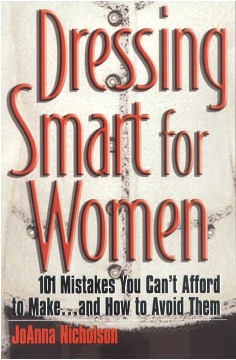
Source: JoAnna Nicholson, Photograph of the Book Dressing Smart for Women, in Impact Publications, https://www.impactpublications.com/product/dressing-smart-for-women/.
In more recent years, women are ditching hardcopies of literature and turning to social media to let each other in on tips and tricks to meet this laundry list of appearance standards. In her post amassing more than 1.4 million views at the time of writing, TikTok user @itsgivingavery shared her experiences with gendered fashion in the corporate law setting. “You do not want to look too attractive at work,” she says. “You do not want to overdress and wear stilettos and like a full face of makeup.”13 Instead, women should sport a neutral manicure, have their hair pulled away from their face in a bun or ponytail, and to wear pants instead of skirts.14
This excessive—and at times counterintuitive—list of women attorneys’ appearance standards begs the question: Is it exhausting and time consuming to try and fit this mold? Absolutely. Working to conform to these standards and “minimize aspects of one’s core identity can cause stress, significantly erode self-esteem, damage emotional well-being, [and] negatively affect physical health.”15 Additionally, there are negative work-related outcomes. The time and mental energy spent assimilating adds up, detracting from clients and the courtroom in the long run.
- The Disparate Impact on Attorneys of Color.
These harms compound for attorneys of color. In a 2023 survey, seven out of ten Black16 women lawyers shared that they experienced workplace discrimination or bias.17 In the courtroom, racial biases weigh against attorneys of color compared to white attorneys.18 These biases and barriers take the form of written and unwritten professionalism rules that impact attorneys of color alone.19 Physical professionalism standards are one set of tools used to police and regulate attorneys of colors’ hair,20 speech,21 and even the food eaten at the office.22
As a white individual lacking the experience and authority to write about this topic, I want to use this section to highlight literature by attorneys of color who have long been documenting this issue, specifically one outstanding article by Shannon Cumberbatch that was a major kick-starter for this blog. Cumberbatch is a staff attorney and recruiting and hiring manager at Bronx Defenders, as well as a co-director of the Bronx Defender’s externship program at Columbia Law School.23 In her law journal article entitled, When Your Identity is Inherently “Unprofessional”: Navigating Rules of Professional Appearance Rooted in Cisheteronormative Whiteness as Black Women and Gender Non-Conforming Professionals, she shares her illuminating interaction with a group of Black women professionals while representing her legal organization at a career fair:
They emphatically discussed the damage and financial expense they incurred to straighten and subdue their naturally coiled, gravity defying hair to appear “polished” and “professional” for their interviews. They shared how they spent several hours in several stores seeking a skirt that would complement their figure, but not emphasize or unveil their curves, and were ultimately forced to splurge on a tailor to appear feminine and physically appealing without being hypersexualized, since the average suit is not designed to fit their body type. They were told to wear these skirt suits with “flesh toned” stockings and “nude” makeup for a “polished” but “professional” look, and reflected upon their frustration running up and down retail aisles seeking “flesh tones” and “nude” colors that actually matched their complexion, since the “darkest” shade of most products still only reflect the darkest tone of white or light skin.24
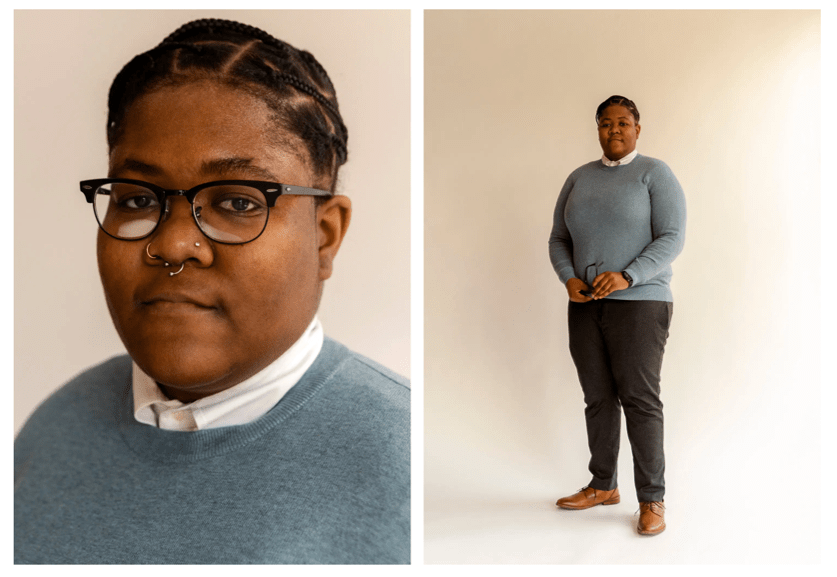
Source: Clement Pascal, Photograph of Mx. Ace Sutherland, in Shane O’Neill, Defining Nonbinary Work Wear, N.Y. Timeshttps://www.nytimes.com/2023/01/09/style/nonbinary-professional-work-attire.html (June 20, 2023).
Not only is the time and energy spent trying to conform to Eurocentric beauty standards detracting from clients and cases, these experiences of conformity, Cumberbatch continues, traumatize Black women.25 Importantly, “it is in fact possible to be successful in law, and to also be yourself, when your being does not fit the prototype prescribed by [cisheterosexual] white male patriarchy.”26
Recognizing that the experience of racism varies across different groups, this blog specifically focuses on how physical professionalism standards manifest for Black attorneys, distinguishing them from those of attorneys of East Asian, Pacific Island, South Asian, and Southeast Asian descent.27 For the sake of brevity, this blog does not touch on the experiences of other groups of attorneys of color. Additionally, this blog does not address non-race-related factors, such as socioeconomic class, immigration status, and disability that also exacerbate issues related to physical professionalism standards. Hopefully, this piece will evolve into a larger article that sheds light on the critical experiences of each of these groups.
- The Gender Dysphoric Struggles of LGBTQ+ Attorneys.
Finally, for members of the LGBTQ+ community, these issues likewise persist. Fashion is one of the first ways we express our authentic selves. We can use clothing to shape our appearances into a gender-affirming experience. Once we enter the professional world, however, clothing can become a burden.
When we face the clients and the courtroom, we must make hyperconscious decisions about our appearances. Coming from my personal experience as a gender-nonconforming individual, despite our preferred gender expression we are expected to dress in a manner conforming to our sexes assigned at birth. As simple as it may seem to rebel against these standards by disregarding them completely, there is an incredibly tangible harm in doing so. We regularly struggle with determining when or where it is safe to wear clothes that do not align with our sexes assigned at birth.
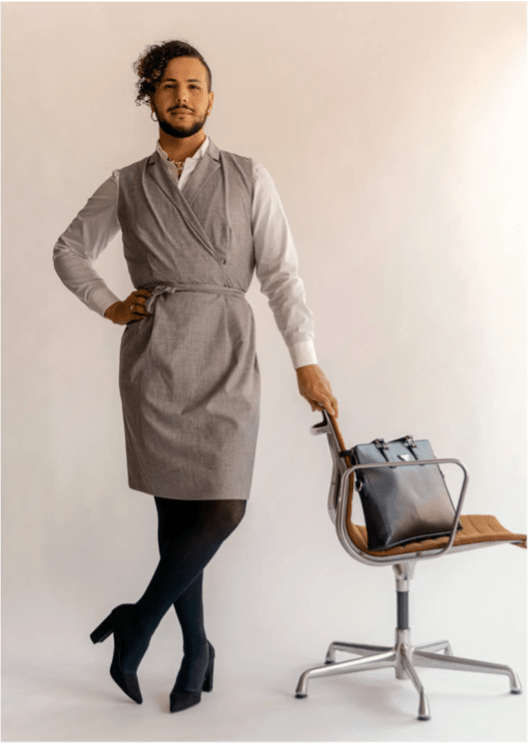
Source: Clement Pascal, Photograph of Mx. Samy Nemir Olivares, in Shane O’Neill, Defining Nonbinary Work Wear, N.Y. Times, https://www.nytimes.com/2023/01/09/style/nonbinary-professional-work-attire.html (June 20, 2023).
This struggle stems from LGBTQ+ individuals’ fear that—in a cisgender-heteronormative society—our gender identities will be disregarded or even challenged, impacting our professional identities as a result. For transgender attorneys amid their transition, they are told things like, “[W]e’re going to have to move you to the back of the room. We don’t want you to be front-facing, client facing.”28 This is despite the fact that “clients are actually more accepting than you would expect.”29
What we wear does not detract from our ability to write a motion to dismiss or deliver an appellate argument. It is the professionalism standards that are the problem. We will never get back the time and mental energy spent debating whether it was professional to wear a skirt, suit, or put on a bold lipstick. We could have been putting that effort towards a groundbreaking civil rights complaint, brainstorming questions for a deposition, or reviewing a critical merger contract. It is time to collectively adapt these physical professionalism standards to the real world—a world that does not fit neatly into the gender binary or racial and ethnic category.
- Solutions: Personal and Institutional Changes.
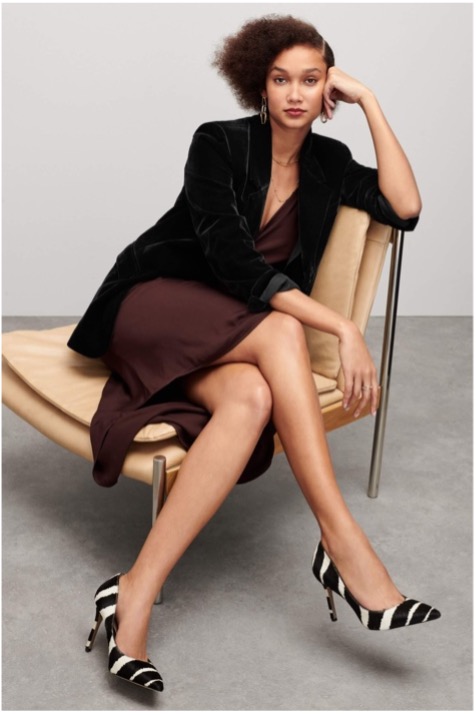
Source: Photograph of Business Professional Attire, in Sheri Epps-Frederito & Alexis Frawley, Women’s Business Professional Attire to Conquer Your Workplace in Style, Stitch Fix (May 24, 2022), https://www.stitchfix.com/women/blog/fashion-tips/business-professional-attire/.
We are all better advocates when we are comfortable. And we are capable of being successful while expressing our genuine selves simultaneously.30 The more time and energy we spend trying to fit ourselves into the boxes that professionalism sets out for us, the more time we waste away from clients and the courtroom.
While some may argue “[b]ig hoop earrings or bold gold chains are not appropriate and will not present you as a serious person even if you are,”31 I respectfully disagree, and it starts with these smaller accessories to make broader, industry-wide change. On a personal level, Cumberbatch calls on us to “continually reflect on [these] assumptions that we’re making about dress and try to make sure that they’re reasonable, they’re accurate, they’re not discriminatory, that they’re not reflecting ill-considered biases.”32
On a broader scale, we need to “consider what messages we are sending about ‘how to look like a lawyer.’”33 These messages come from the legal field’s core institutions. Legal employers alike—firms, government, and in-house—need to update and adapt their dress codes, and employers must implement effective diversity, equity, and inclusion programs that specifically eliminate appearance professionalism-related implicit biases.34 Similar extensive work is required at the law school level.35 Messages about “how to look like a lawyer” also come from media. Many come to law school inspired by movies, shows, and books like Legally Blonde, Suits, and John Grisham’s The Firm. The more the media deconstructs professionalism standards in the legal field—casting, costuming, and applying makeup in ways that challenge Eurocentric, cisgender-heterosexual standards—the image of the white, well-dressed lawyer we all know well will begin to change.
* Alena Stankaitis, J.D. Candidate, University of St. Thomas School of Law Class of 2025, Associate Editor of the University of St. Thomas Law Journal. Alena’s preferred pronouns are they/them/theirs and she/her/hers.
- Profile of the American Legal Profession, A.B.A. (2023), https://www.americanbar.org/content/dam/aba/administrative/news/2023/potlp-2023.pdf. ↩︎
- Id. at 22. ↩︎
- Id. at 23. ↩︎
- See Kate Morgan, How Young Workers are Changing the Rules of ‘Business Speak’, BBC (Feb. 28, 2022), https://www.bbc.com/worklife/article/20201204-how-young-workers-are-changing-the-rules-of-business-speak (explaining how younger generations are revolutionizing business communication); see also Michele Parmelee, Making Waves: How Gen Zs and Millennials are Prioritizing—and Driving—Change in the Workplace, Deloitte Insights (May 17, 2023), https://www2.deloitte.com/us/en/insights/topics/talent/recruiting-gen-z-and-millennials.html (detailing what Gen Z and Millennials look for in a workplace and how they are reshaping corporate culture). ↩︎
- Brenda Swauger, 9 Tips on How to Dress for the Courtroom, A.B.A. J. (Jan. 16, 2020, 6:30 AM), https://www.abajournal.com/voice/article/how-to-dress-for-the-courtroom. ↩︎
- Patricia Fersch, How Young Law Graduates or Lawyers Should Dress, Forbes (Oct. 28, 2020, 12:33 PM),
https://www.forbes.com/sites/patriciafersch/2020/10/28/how-should-young-law-graduates-or-lawyers-dress/?sh=75fac0ce68b1. ↩︎ - Someone who is “cisgender” has a “gender identity [that] corresponds with the sex the person was identified as having at birth.” Cisgender, Merriam-Webster, https://www.merriam-webster.com/dictionary/cisgender (last visited Dec. 7, 2023). ↩︎
- See Antonia Noori Farzan, Five Years Ago, Obama Was Blasted for Wearing a Tan Suit. Now, It’s Used to Contrast Him with Trump, Wash. Post (Aug. 28, 2019, 6:56 AM), https://www.washingtonpost.com/nation/2019/
08/28/tan-suit-scandal-obama-trump/. ↩︎ - See Justin Sink, WH: Obama Stands by Tan Suit, The Hill (Aug. 29, 2014, 12:09 PM), https://thehill.com/homenews/administration/216247-wh-obama-feels-pretty-good-about-tan-suit/ (publishing the White House Press Secretary’s answers to questions about President Obama’s reaction to the public outcry about his tan suit). ↩︎
- See Kate Bennett, Lessons from Obama’s Tan Suit 5th Anniversary, CNN (Aug. 28, 2019, 10:29 PM), https://www.cnn.com/2019/08/28/politics/barack-obama-tan-suit-fifth-anniversary/index.html (“Yet, when the news conference ended, the general talk of the day was not about a lack of strategy in the fight against a terror group in the Middle East. Instead, it was about taupe, the color of the suit Obama was wearing that day.”). ↩︎
- Marisa Lati, Amy Coney Barrett Was Criticized for Her Dress, Part of a Long History of Judging Women’s Clothes, Wash. Post (Oct. 13, 2020, 4:50 PM), https://www.washingtonpost.com/lifestyle/2020/10/13/amy-coney-barrett-dress-criticism/. ↩︎
- Dressing Smart for Women: 101 Mistakes You Can’t Afford to Make . . . and How to Avoid Them, Impact Publications, https://www.impactpublications.com/product/dressing-smart-for-women/ (last visited Dec. 7, 2023) (scroll down to see “Description”). ↩︎
- Avery (@itsgivingavery), TikTok (Oct. 29, 2023), https://www.tiktok.com/t/ZT8AFUkLn/. ↩︎
- Celeste Aria (@celeste.aria_), TikTok (Nov. 3, 2023), https://www.tiktok.com/t/ZT8AFPmyr/. ↩︎
- Elizabeth B. Cooper, The Appearance of Professionalism, 71 Fla. L. Rev. 1, 7–8 (2019). ↩︎
- Taking a page out of both Shannon Cumberbatch and Kimberlé Crenshaw’s books, I capitalize “Black” because “Black [people], like Asian [people], Latin[x/e] and other ‘minorities,’ constitute a specific cultural group and, as such, require denotation as a proper noun . . . I do not capitalize ‘white,’ which is not a proper noun, since [neither] white people nor ‘people of color’ refers to a specific cultural group.” Kimberlé Crenshaw, Mapping the Margins: Intersectionality, Identity Politics, and Violence against Women of Color, 43 Stan. L. Rev. 1241, 1244 n.6 (1991). ↩︎
- Brenda Sapino Jeffreys, Black Women Lawyers Still Experience, See Discrimination in Workplace, Survey Finds, Law.com (Aug. 8, 2023, 1:30 PM), https://www.law.com/americanlawyer/2023/08/08/black-women-lawyers-still-
experience-see-discrimination-in-workplace-survey-finds/?slreturn=20231104191010. ↩︎ - Alexis A. Robinson, The Effects of Race and Gender of Attorneys on Trial Outcomes, 23 Jury Expert 1, 3 (2011) (“[W]hen the attorneys’ cases are evenly matched, the [w]hite male attorney is more likely to win than the Black and/or female attorney.”); see also Samuel R. Sommers, Sam Sommers Responds to Alexis Robinson’s Article on Attorney Race and Gender, 23 Jury Expert 22, 22 (2011) (“As a research psychologist, I am well versed in the ways in which expectation and presumption bias daily perception . . . I find it fascinating when someone suggests that this part of human nature doesn’t extend to the courtroom.”). ↩︎
- See S. Mitra Kalita, How ‘Professionalism’ Harms Workers of Color, TIME (July 25, 2023, 7:30 AM), https://time.com/charter/6297289/professionalism-racism/ (“[S]ome workplaces that have rules that discriminate against Black people’s natural hair texture and the styles that come with it. But this manifests behaviorally, too. If you take two people of equal position—one who is white and the other Black—and the white colleague raises their voice and disrespects the Black colleague, there may be more scrutiny and focus on the Black colleague’s reaction than the actual offensive conduct.”). ↩︎
- See Shahamat Uddin, Racism Runs Deep in Professionalism Culture, Tulane Hullabaloo (Jan. 23, 2020), https://tulanehullabaloo.com/51652/intersections/business-professionalism-is-racist/ (“Discriminatory policies towards Black people’s hair dates as far back as America’s independence . . . Black people’s hair is still policed in the workforce today. A corporate board recruiter quoted that she would much rather hire a woman with a sleek ponytail than one with a natural hairstyle such as locs or an Afro.”). ↩︎
- See id. (“Speaking non-english languages in the breakroom or talking in different languages with a colleague are practices that are seen as ‘unprofessional’ when they are really just ways of life for people . . . Professionalism is an entitlement to other people’s speech.”). ↩︎
- See Leah Goodridge, Professionalism as a Racial Construct, 69 UCLA L. Rev. Discourse 38, 41 (2022) (“The workplace is never the time to be Brown or Black . . . Professionalism will ask me not to bring my cultural food that ‘stinks up the entire break lounge.’”). ↩︎
- Shannon Cumberbatch, Columbia L. Sch. Faculty, https://www.law.columbia.edu/faculty/shannon-cumberbatch (last visited Dec. 8, 2023). ↩︎
- Shannon Cumberbatch, When Your Identity is Inherently “Unprofessional”: Navigating Rules of Professional Appearance Rooted in Cisheteronormative Whiteness as Black Women and Gender Non-Conforming Professionals, 34 J. Civ. Rts. & Econ. Dev. 81, 81–82 (2021). ↩︎
- Id. at 82. ↩︎
- Id. (emphasis added). ↩︎
- See Evelyn R. Carter & Mary C. Murphy, Group-Based Differences in Perceptions of Racism: What Counts, to Whom, and Why?, 9 Soc. & Personality Psych. Compass 269, 277 (2015) (“It is also important to consider when perceptions of racism in American society are similar or different among members of other minority groups (e.g., Latinos and Asians). For example, recent research revealed that status differences between [Black] and Asian Americans were partially responsible for whether members of those groups perceived an organization as racially diverse or not . . . [T]his paper emphasizes the importance of exploring the, potentially unique, perceptions of members of different racial minority groups.”). ↩︎
- Julianne Hill, Keeping Up Appearances: Slow-to-Evolve Dress Codes Often Burden Female and Minority Lawyers, A.B.A. J. (Oct. 1, 2023, 4:10 AM), https://www.abajournal.com/magazine/article/keeping-up-
appearances-slow-to-evolve-dress-codes-often-burden-female-and-minority-lawyers. ↩︎ - Id. ↩︎
- See Cumberbatch, supra note 24, at 82. ↩︎
- Fersch, supra note 6. ↩︎
- Hill, supra note 28. ↩︎
- Ann Juliano, How to Look Like a Lawyer, 34 J. Civ. Rts. & Econ. Dev. 151, 151 (2021). ↩︎
- See Cooper, supra note 15, at 47–52, 63 (outlining specific plans legal employers can implement to effectuate internal change). ↩︎
- See id. at 52–61 (suggesting new institutional priorities, roles for law school administrators, and roles for faculty members to adopt); see also Rebekah Hanley & Malcolm McWilliamson, Model Dress Code: Promoting Genderless Attire Rules to Foster an Inclusive Legal Profession, 34 J. Civ. Rts. & Econ. Dev. 125, 129–132 (2021) (outlining recommendations for genderless dress codes that can be taught in law schools). ↩︎
 University of St. Thomas Law Journal
Leave a comment