Megan J. Miller*
Introduction:
Woody Guthrie wrote “This Land Is Your Land,” which has become like an “alternative national anthem.”1 Although seen by most Americans as a “patriotic anthem” emphasizing that “we are all equally entitled to the rights of this country, including the land we stand on,” not everyone shares that same sentiment.2 Native Americans, specifically, may quickly point out that the song’s apparent meaning “falls flat”3 of the equality and opportunity-for-all that is portrayed by the lyrics.4 Instead, they might share that the song reflects “a wholly colonialist message” that “plays into America’s continual erasure of Indigenous peoples in culture.”5 Native American sovereignty battles are nothing new, and the question has really become “Whose land is this land?”6 This is the exact issue the Eight Circuit Court of Appeals is set to decide between Mille Lacs County and the Mille Lacs Band of Ojibwe, with a sweeping 57,000 acres worth of land in dispute.7
Mille Lacs:
The Mille Lacs Band of Ojibwe (“the Band”) is one of seven federally recognized Native American reservations located within Minnesota.8 The Band’s “history dates back more than 250 years” to when their ancestors settled in East Central Minnesota on the southwestern shores of Mille Lacs Lake.9 On February 22, 1855, the Treaty with the Chippewa was signed, which established the Mille Lacs Reservation as “a permanent homeland for the Mille Lacs Band of Ojibwe” and comprised roughly 61,000 acres.10 This acreage falls within Mille Lacs County,11 and has been the issue in multiple lawsuits between the two parties.12
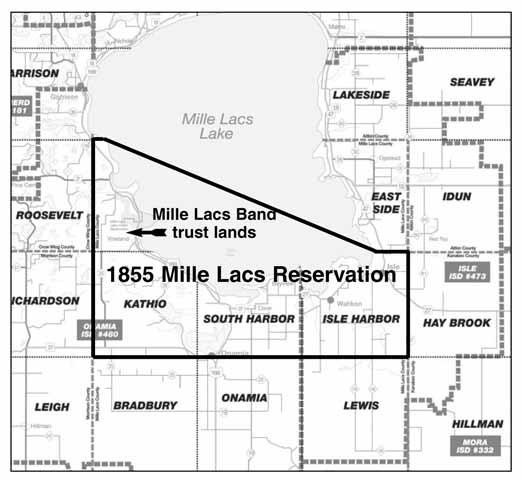
While this issue is once again at the core of litigation between the parties, the Reservation boundary it not directly what led the Band to file their most recent lawsuit. Rather, the Band brought suit against Mille Lacs County, the Mille Lacs County Attorney, and the Mille Lacs County Sheriff (collectively, “the County”) in November 2017,14 seeking declaratory and injunctive relief due to ongoing interference with the Band’s law enforcement authority within the Reservation.15 At the core of deciding whether the County overstepped their bounds stands the question: what are the Reservation’s boundaries?16 To answer this question and better understand the impacts of this lawsuit, we must put the case into context with some brief—and a little complicated—background underlying tribal policing in Minnesota and the Mille Lacs Band specifically.
Tribal Law Enforcement Background:
Prior to 1953, all Native American communities shared criminal jurisdiction with the federal government, while state/county governments and police rarely intervened unless both parties were non-Native.17 In 1953, Public Law 280 (“PL 280”) passed, codifying 18 U.S.C. § 1162 which applies state criminal laws to reservations and gives the applicable states and their Native nations concurrent jurisdiction.18 As a result, nontribal law enforcement in PL 280 states have greater authority on tribal reservations.19
As one attempt to mitigate negative impacts PL 280 had on tribal sovereignty, Minnesota passed a statute that applied only to Mille Lacs Band’s law enforcement authority within the Mille Lacs Reservation and certain trust lands.20 Today, the statute gives the Band Police Department the “powers of a law enforcement agency” under state law if certain conditions are met.21 The statute used to require the Band and County Sheriff to enter into a cooperative agreement that defined and regulated the law enforcement services and trust property involved in the agreement.22 However, as of June 30, 2023—presumably due to this litigation—the statute was revised, changing “shall enter into” an agreement to “may enter into,” and took out the requirement that the agreement must define the trust property involved.23
In 2008, the County Sheriff and the Band entered into a cooperative agreement that allowed for more independent exercise of tribal criminal authority: no reporting to the county attorney; reporting to the Band’s Police Chief and Solicitor General; may consult with Solicitor General about duties; and “nothing in this agreement shall authorize, govern or limit the Band’s exercise of its own law enforcement authority or the Band’s prosecution of any crime or traffic offense within its prosecutorial jurisdiction.”24 The Band and County operated under this new agreement without issue until 2013, when the Band applied for the assumption of concurrent federal criminal jurisdiction within the Band’s Indian country under the Tribal Law and Order Act.25 The County opposed the application, believing the Reservation had been disestablished from the 1855 boundaries.26 Thus started the escalation of the law enforcement tension between the Band and County that led to this litigation.
Following the Interior Solicitor’s opinion in 2015 finding the original Reservation boundaries of 1855 remaining intact,27 the County terminated the 2008 cooperative agreement in June 2016 after considering their overall deteriorating relationship and “lack of communication” with the Band.28 After failed attempts to negotiate a new agreement or receive an opinion from the Attorney General, the County Attorney issued an Opinion and Protocol (the “Northern Protocol”) that described the Band’s limited police authority after the agreement’s termination.29 He felt the agreement was a condition necessary for the Band to exercise its law enforcement authority under Minnesota Statute section 626.90.30 Based on application of State law and current agreements, the County Attorney believed the Band Police Department was not a state law enforcement agency in Mille Lacs County, and thus the Band’s authority: “(1) was limited to trust lands and did not extent to non-trust lands within the original Reservation boundaries; (2) did not include authority to investigate state-law violations, even on trust lands; and (3) did not include authority to investigate non-Indians.”31 Further, County Deputies were expected to uphold the Northern Protocol, and the Band’s declaration stated their officers were “warned of [civil and criminal] legal liability that might follow” unauthorized conduct.32 This position was maintained even after the Band’s officers “were deputized and issued Special Law Enforcement Commissions (“SLECs”) to enforce federal law within the Band’s Indian country.”33
As expected, the Northern Protocol increased tensions between the Band and County exponentially and ultimately led to the Band filing their lawsuit in 2017.
District Court’s Decisions:
The litigation of this case is complex, involving several lengthy rulings from Senior United States District Judge Susan Nelson. In December 2020, she issued an opinion discussing the County’s interference with the Band’s law enforcement authority by the execution of the Northern Protocol, the harm it caused the Band Police Department’s morale, the risk it created for public safety, and ultimately the decision that the Band could continue with its lawsuit against the County.34
The next published decision was issued in March 2022, where she ruled on the Reservation boundary issue.35 This decision walked through an extensive history, interpretation, and analysis of relevant treatises, acts, and resolutions, from 1855 through today.36 The power to diminish reservation land lies only with Congress, and “Congress’s intent to disestablish a reservation ‘must be clear.’”37 Analyzing each of the relevant pieces of legislation, Judge Nelson confirmed the Band’s position: “Over the course of more than 160 years, Congress has never clearly expressed an intent to disestablish or diminish the Mille Lacs Reservation.”38
By the Treaty of 1855, the Band was promised a ‘permanent home[ ]’ at Lake Mille Lacs. Following the Band’s defense of the United States during the uprisings of 1862, the Band received special treatment in the Treaties of 1863 and 1864 . . . Article 12 proviso permitted the Mille Lacs band to remain on their reservation during their good behavior.39
…
The [Nelson] Act . . . expressly permitted the Mille Lacs to take allotments on the reservation . . . . [This] do[es] not reflect the clear intention required for this Court to find disestablishment. Nor do the Resolutions of 1893 and 1898 (which merely permitted disposal of reservation lands in violation of the Nelson Act), or the 1902 Act (which preserved the Band’s rights under prior treaties) . . . .40
In January 2023, Judge Nelson issued her last sizeable opinion on the matter.41 This decision specifically dismissed the claims against the County Attorney and County Sheriff only in their individual capacity, and discussed the tribe’s law-enforcement authority within the 1855 Reservation boundary to investigate violations of federal, state, and tribal law by any suspect as well as temporarily detain and investigate non-Indian suspects for a reasonable period of time.42
Thus, this line of decisions left the Band possessing the “inherent sovereign law enforcement authority” within the Reservation as was originally given to them back in 1855 under the Treaty with the Chippewa.43
So… What’s Next? And What Does This Mean For Non-Tribe Members?
It should come as no surprise that as of February 2023, the County filed an appeal with the Eighth Circuit.44 Looking ahead, oral arguments will likely be heard by the court in summer or fall of 2024, with their ruling to follow sometime in late 2024.45
There are many people invested in the outcome of this case. Five amicus curiae briefs have been filed thus far, with six parties supporting appellants (the County) and six parties supporting appellees (the Band).46 The County states the Reservation boundary is not only important to them, but also to “the townships and cities in the disputed area, and the thousands of non-members who live on and own lands, homes, and businesses within the 61,000 acres of the former reservation.”47 The local townships echo this concern, speaking to the “disruptive” nature of the Band’s claim that would: deprive them of significant jurisdiction; cause them to “face an entirely new law enforcement landscape”; lead to “drastic” taxation and zoning consequences; and “subject them to burdensome and inefficient oversight from the Band and federal government” when, for example, trying to approve critical small-town projects.48 The State of Minnesota tried to put some of these concerns to rest by stating that “State and local units of government will continue to have jurisdiction over nonmembers in the vast majority of circumstances throughout the Mille Lacs Reservation” and be able to “tax fee lands purchased by a band from non-members.”49 The State also lists “activities nonmembers may engage in free of band regulation” that will not affect their daily lives, including: hunting or fishing on fee lands; buying or selling land; operating a hotel; driving on public roads; building a house; enforcing intellectual property rights; leasing oil and gas rights; hiring or supervising employees, including band members; running a school; and operating a utility.50
The practical implications of what this decision may mean for people living within the disputed land are very real. The Mille Lacs Band of Ojibwe and Mille Lacs County land dispute is a unique debate not experienced by any other tribe within Minnesota. How the Eighth Circuit decides to answer the questions in front of them is yet to be seen, but one thing is for sure: we will finally get an answer to Woody Guthrie’s controversial patriotic anthem—whose land really is this?
*Megan J. Miller, J.D. Candidate, University of St. Thomas School of Law Class of 2024. Articles Editor, University of St. Thomas Law Journal. I want to extend a personal thank you to both Mille Lacs County Sheriff, Kyle Burton, for providing me with his extensive presentation PowerPoints, and Monte Fronk—a member of the Mille Lacs Band of Ojibwe and the Emergency Management Officer for the Tribal Police Department—for his insight and guidance on my initial tribal research.
- Sam Yellowhorse Kesler, The Blind Spot in the Great American Protest Song, NPR (Feb. 3, 2021, 9:01 AM ET), https://www.npr.org/2021/02/03/963185860/the-blind-spot-in-the-great-american-protest-song. ↩︎
- Id. ↩︎
- Mali Obomsawin, This Land Is Whose Land? Indian Country and the Shortcomings of Settler Protest, Folklife (June 14, 2019), https://folklife.si.edu/magazine/this-land-is-whose-land-indian-country-settler-protest.
↩︎ - Kesler, supra note 1. ↩︎
- Kesler, supra note 1. ↩︎
- Obomsawin, supra note 3. ↩︎
- Compare Mille Lacs Band of Ojibwe et al. v. Cnty. of Mille Lacs (MLBO II), 589 F. Supp. 3d 1042, 1096 (D. Minn. 2022) (affirming the Mille Lacs reservation’s boundaries consist of the total 61,000 acres given under the 1855 Treaty), with The Mille Lacs Band’s Recent Legal Victory, Native Governance Ctr. (Feb. 28, 2023), https://nativegov.org/news/the-mille-lacs-bands-recent-legal-victory/ (showing the county insists that the Reservation is diminished to only 4,000 acres).
↩︎ - See Minnesota Indian Tribes, Minn., https://mn.gov/portal/government/tribal/mn-indian-tribes/ (last visited Mar. 1, 2024). ↩︎
- Culture, Mille Lacs Band of Ojibwe, https://millelacsband.com/home/culture (last visited Mar. 1, 2024). ↩︎
- Treaties, Mille Lacs Band of Ojibwe, https://millelacsband.com/home/treaties (last visited Mar. 1, 2024); see also Treaty with the Chippewa art. 2, Feb. 22, 1855, 10 Stat. 1165. ↩︎
- See Complaint at 3, Mille Lacs Band of Ojibwe et al. v. Cnty. of Mille Lacs (MLBO III), 650 F. Supp. 3d 690 (D. Minn. 2023) (No. 17-cv-05155) (SRN/LIB).
↩︎ - See Treaties, supra note 10 (“In 2002, the Mille Lacs County Board of Commissioners filed a federal lawsuit against the Mille Lacs Band regarding the existence of reservation boundaries. The suit was dismissed by a series of lower courts, and the U.S. Supreme Court refused to hear the case.”).
↩︎ - Illustration of the original 1855 Mille Lacs Reservation trust lands on the southwest shores of Mille Lacs Lake, in Brett Larson, County Opposes Federal Jurisdiction, Mille Lacs Messenger (May 8, 2013), https://www.messagemedia.co/millelacs/news/tribal/county-opposes-federal-jurisdiction/article_b58c7324-b71c-11e2-a611-001a4bcf6878.html.
↩︎ - See Complaint at 1, 8, Mille Lacs Band of Ojibwe et al. v. Cnty. of Mille Lacs (MLBO III), 650 F. Supp. 3d 690 (D. Minn. 2023) (No. 17-cv-05155) (SRN/LIB).
↩︎ - MLBO II, 589 F. Supp. 3d at 1049.
↩︎ - See id. ↩︎
- It’s Time to End Public Law 280, Native Governance Ctr. (Aug. 9, 2021), https://nativegov.org/news/its-time-to-end-public-law-280/. ↩︎
- The Mille Lacs Band’s Recent Legal Victory, supra note 7. PL280 applies to Alaska, California, Minnesota, Nebraska, Oregon, and Wisconsin. Tribal Crime and Justice: Public Law 280, Nat’l Inst. of Just. (May 19, 2008), https://nij.ojp.gov/topics/articles/tribal-crime-and-justice-public-law-280. ↩︎
- Tribal Crime and Justice, supra note 18. ↩︎
- Ch. 189, H.F. 1125, 77th Leg., 1991 Reg. Sess. (Minn. 1991). ↩︎
- Minn. Stat. § 626.90, subd. 2(a)(1–4) (2022). ↩︎
- Minn. Stat. § 626.90, subd. 2(b) (2007). ↩︎
- 2023 Minn. Sess. Law Serv. Ch. 52, S.F. No. 2909 (West). ↩︎
- E-mail from Kyle Burton, Mille Lacs County Sheriff, of PowerPoint on Tribal Law Enforcement in Mille Lacs County to author, (Oct. 11, 2023, 1:03 PM CST) (on file with author). ↩︎
- See MLBO III, 650 F. Supp. 3d 690, 696 (D. Minn. 2023); 18 U.S.C. § 1162(d). ↩︎
- See MLBO III, 650 F. Supp. 3d at 696; Brief of Plaintiffs-Appellees Mille Lacs Band of Ojibwe, et al. at 75, Mille Lacs Band of Ojibwe et al. v. Cnty. of Mille Lacs (MLBO III), 650 F. Supp. 3d 690 (D. Minn. 2023), appeal docketed, No. 23-1261 (8th Cir. Feb. 9, 2023), 2023 WL 6317854, at *58. ↩︎
- See MLBO III, 650 F. Supp. 3d at 696. ↩︎
- E-mail from Kyle Burton, supra note 24. ↩︎
- See MLBO III, 650 F. Supp. 3d at 697. ↩︎
- See id. ↩︎
- Brief of Plaintiffs-Appellees, supra note 26, at 76. ↩︎
- See MLBO III, 650 F. Supp. 3d at 699. ↩︎
- Id. at 703. ↩︎
- See generally Mille Lacs Band of Ojibwe et al. v. Cnty of Mille Lacs (MLBO I), 508 F. Supp. 3d 486 (D. Minn. 2020). ↩︎
- See generally MLBO II, 589 F. Supp. 3d 1042 (D. Minn. 2022). ↩︎
- Id. ↩︎
- Id. at 1081 (quoting Nebraska v. Parker, 588 U.S. 481, 488 (2016)). ↩︎
- Id. at 1096. ↩︎
- Id. at 1095. ↩︎
- Id. at 1096 ↩︎
- See generally MLBO III, 650 F. Supp. 3d 690 (D. Minn. 2023). ↩︎
- See MLBO III, 650 F. Supp. 3d at 706–11, 723–25. ↩︎
- Id. at 730. ↩︎
- Mille Lacs Band of Ojibwe, et al. v. Cnty. of Mille Lacs, Minn., 650 F. Supp. 3d 690 (D. Minn. 2023), appeal docketed, No. 23-1261 (8th Cir. Feb. 9, 2023). ↩︎
- See id. (showing letters in the docket proceedings on November 2023 from Mille Lacs County and January 2024 from Mille Lacs Band regarding “availability for oral argument”). ↩︎
- See id. ↩︎
- Reply Brief of Appellant County of Mille Lacs, Minnesota at 8, Mille Lacs Band of Ojibwe, et al. v. Cnty. of Mille Lacs (MLBO III), 650 F. Supp. 3d 690 (D. Minn. 2023), appeal docketed, No. 23-1261 (8th Cir. Feb. 9, 2023), 2023 WL 7552269, at *1. ↩︎
- Brief of Amicus Curiae City of Wahkon, et al., in Support of Appellant County of Mille Lacs, Minnesota and in Support of Reversal of the Decision Below at 5, 25–27, Mille Lacs Band of Ojibwe et al. v. Cnty. of Mille Lacs (MLBO III), 650 F. Supp. 3d 690 (D. Minn. 2023), appeal docketed, No. 23-1261 (8th Cir. Feb. 9, 2023), 2023 WL 3661260, at *5, *25–27. ↩︎
- Brief of Amicus Curiae State of Minnesota in Support of Plaintiff-Appellee Mille Lacs Band of Ojibwe and in Support of Affirming the District Court at 11, 14, Mille Lacs Band of Ojibwe, et al. v. Cnty. of Mille Lacs (MLBO III), 650 F. Supp. 3d 690 (D. Minn. 2023), appeal docketed, No. 23-1261 (8th Cir. Feb. 9, 2023), 2023 WL 6543156, at *11, *14. ↩︎
- Id. at 8–9. ↩︎
 University of St. Thomas Law Journal
Leave a comment