Matthew Koop*
While the most famous penguin-villain comes from the DC Universe, the most sinister penguin-villain comes from Wallace & Gromit. Feathers McGraw, the silent and mysterious antagonist from Wallace & Gromit: The Wrong Trousers, displays a cunning, slippery version of criminality that warrants closer examination. Through his savvy use of disguises (such as a chicken, a nun, and a bowling pin), McGraw maneuvers the criminal underworld bouncing from crime to crime, ranging from burglary to false imprisonment. This blog post examines these crimes under a legal lens and seeks to explain how these actions would be addressed in a criminal court. By exploring this topic, we gain a deeper understanding of both the mechanics of criminal justice and Feathers McGraw himself.
I. Theft and Burglary
The Wrong Trousers introduces Feathers McGraw’s crafty criminality via his theft of the Blue Diamond.1 In Minnesota, theft requires an intent to permanently deprive another of property, and theft of property worth $35,000 or more may result in up to 20 years in prison.2 McGraw unequivocally satisfies any mens rea requirement given his meticulous and thoughtful preparation leading up to the execution of the crime, spending days setting up the trousers and staking out the museum.3 While we do not have an exact value of the Blue Diamond, given its size and the fact it’s in a secured display in a museum we can assume it is worth more than $35,000.4
At first glance, one might think that there may be an accompanying theft claim because of McGraw’s use of Wallace’s mechanical trousers. However, theft requires an intent to permanently deprive the rightful owner of their property.5 McGraw would point to the fact that once he obtained the diamond, he relinquished control of the trousers and returned them to Wallace’s home.6 It would be challenging for a prosecutor to satisfy this permanent element.
McGraw could also be charged with burglary. Minnesota defines burglary as “enter[ing] a building without consent and with intent to commit a crime.”7 In obtaining the Blue Diamond, McGraw didn’t just waltz into an open space and put it in his pocket. Through his remote control, McGraw directed the trouser-bound and sleep-induced Wallace8 through the building’s ventilation system, past the security system, and eventually out of a window after the diamond was secured.9 Additionally, it would likely be burglary in the second degree since first-degree burglary in Minnesota is reserved for (1) occupied dwellings, (2) armed burglars, and (3) assaults at the scene of the burglary.10 McGraw’s actions did not involve any of these.11 Also, second-degree burglary is specifically applicable to McGraw’s burglary of a museum, since a museum would likely be considered a “historic property.”12
II. Animal Cruelty and Attempted Murder
In the final moments of The Wrong Trousers, McGraw draws a revolver while trying to flee on a high-speed model train.13 In trying to capture McGraw and secure the diamond, Gromit (a beagle) braved an onslaught of gunfire.14 In Minnesota, animal cruelty is defined as “willfully instigat[ing] or in any way further[ing] any act of cruelty to any animal or animals.”15 The prosecution would likely try and introduce the plastic lamp shade Gromit was using as a helmet, as it bears the heat-scars from the bullets it deflected.16 A savvy defense team might point to how the Minnesota statute begins with “[n]o person shall,”17 since McGraw is a penguin.18 Does a penguin qualify as a person?
Any attempted murder charge relating to firing the gun at Gromit is likely off the table, given that Minnesota statutes require the victim to be a “human being.”19
However, McGraw directs gunfire not only at Gromit, but Wallace as well.20 Attempted crimes in Minnesota are governed by § 609.17.21 At first glance, one might think that McGraw would face attempted second-degree murder instead of first-degree, since there is no evidence that his use of his revolver was premeditated. It was more spur-of-the-moment, an attempt to distance himself from his chasers. However, subdivision 3 of § 609.185 applies if the act occurs “while committing or attempting to commit burglary.”22 Given the circumstances, he would likely be charged with attempted murder in the first degree. McGraw might argue that the burglary had already been completed and that his was an entirely separate act no longer connected to the timeline of the burglary. If he could successfully eliminate the contention that he fired his gun during the commission of the burglary, he might be able to bring this down to second-degree.
Additionally, given that this took place on a railroad, it may bring in the federal government. The federal government has jurisdiction over crimes that occur on railway and mass transportation systems.23 The relevant statute defines “railroad” as:
A. [A]ny form of nonhighway ground transportation that runs on rails or electromagnetic guideways, including—
(i) commuter or other short-haul railroad passenger service in a metropolitan or suburban area and commuter railroad service that was operated by the Consolidated Rail Corporation on January 1, 1979; and
(ii) high speed ground transportation systems that connect metropolitan areas, without regard to whether those systems use new technologies not associated with traditional railroads; but
B. does not include rapid transit operations in an urban area that are not connected to the general railroad system of transportation.”24
McGraw’s defense team would likely focus on the latter portion of that definition, given that the railroad was not connected to any general railroad system, since it was confined to a few square feet of track in Wallace’s family room.25
III. False Imprisonment
To obtain the Blue Diamond, McGraw devises the ingenious plan of restraining Wallace within the mechanical trousers and hijacking his movement.26 In Minnesota, false imprisonment is defined as “intentionally confin[ing] or restrain[ing] someone else . . . without that person’s consent.”27 Here, it was impossible for Wallace to provide the necessary consent since he was sleeping.28 Also, he is effectively locked into the mechanical trousers, which indicates that McGraw knew he lacked consent, and that he assumed Wallace would try and escape them if he regained consciousness. This lack of consent is further evidenced by Wallace’s reaction when he wakes up amidst the blaring alarms after triggering the museum’s security system, and says “[W]here the Devil am I? . . . [W]hat’s going on?”29
IV. Identity Fraud
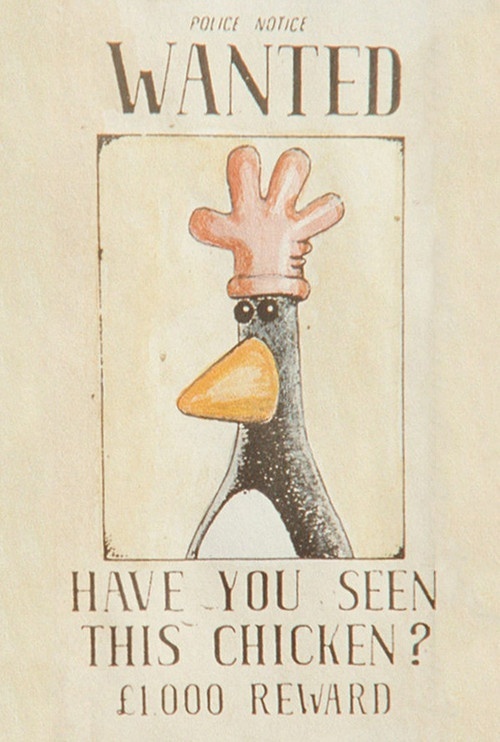
McGraw is infamous for his ability to impersonate other animals and objects. This is shown through the wanted signs displaying an image of McGraw wearing a chicken hat, bearing the question “have you seen this chicken?”30 In Vengeance Most Fowl, he nearly achieves escape by impersonating a nun.31 However, it is unlikely these actions would qualify as identity fraud as there is no indication that he is impersonating a specific nun or a specific chicken.32 However, Minnesota does have a statute for concealing one’s identity.33 While a misdemeanor might seem like a drop in the bucket given the other crimes, I don’t think anyone would feel bad if a prosecutor “threw the book” at McGraw.
V. Conclusion
As I have made clear, Feathers McGraw is far more than a silent antagonist in a beloved stop-motion film—he is a criminal mastermind whose actions would have serious legal consequences in the real world. The next time you watch The Wrong Trousers or Vengeance Most Fowl, consider this: Feathers McGraw’s penguin exterior may seem adorable and child-friendly, but his criminal record is anything but. Through his actions, we see the potential for even animated characters to reflect real-world concerns about justice and the rule of law. McGraw serves as a reminder that appearances can be deceiving, and even the most seemingly innocuous figures can harbor a darker side.
*Matthew Koop, J.D. Candidate, University of St. Thomas School of Law Class of 2025 (Senior Editor).
- Wallace & Gromit: The Wrong Trousers (Aardman Animations 1993) [hereinafter The Wrong Trousers]. ↩︎
- Minn. Stat. § 609.52, subd. 2-3 (2024). ↩︎
- The Wrong Trousers, supra note 1. ↩︎
- Mike Fried, Diamond Prices: A Complete Guide, The Diamond Pro (last updated Jan. 6, 2025) https://www.diamonds.pro/education/diamond-prices/ [https://perma.cc/6MTQ-3GKR]. ↩︎
- Minn. Stat. § 609.52, subd. 2 (2024). ↩︎
- The Wrong Trousers, supra note 1. ↩︎
- Minn. Stat. § 609.582, subd. 2 (2024). ↩︎
- See infra Section III for further discussion on false imprisonment. ↩︎
- The Wrong Trousers, supra note 1. ↩︎
- Minn. Stat. § 609.582, subd. 1(a)-(c) (2024). ↩︎
- The Wrong Trousers, supra note 1. ↩︎
- Minn. Stat. § 609.582, subd. 2(b) (2024). ↩︎
- The Wrong Trousers, supra note 1. ↩︎
- The Wrong Trousers, supra note 1. ↩︎
- Minn. Stat. § 343.21, subd. 7 (2024). ↩︎
- The Wrong Trousers, supra note 1. ↩︎
- Minn. Stat. § 343.21, subd. 7 (2024) (emphasis added). ↩︎
- Compare Penguins, Basic Biology (last updated Dec. 16, 2015) https://basicbiology.net/animal/birds/penguin#google_vignette [https://perma.cc/B8VU-6HYV], with Homo Sapiens, Smithsonian (last updated Jan. 3, 2024) https://humanorigins.si.edu/evidence/human-fossils/species/homo-sapiens [https://perma.cc/4F3S-YAKB] [hereinafter Homo Sapiens]. ↩︎
- Minn. Stat. §§ 609.185-609.195 (2024); Compare Beagle, American Kennel Club (last visited Jan. 24, 2025) https://www.akc.org/dog-breeds/beagle/ [https://perma.cc/ZZN6-FR42], with Homo Sapiens, supra note 18. ↩︎
- The Wrong Trousers, supra note 1. ↩︎
- Minn. Stat. § 609.17 (2024). ↩︎
- Minn. Stat. § 609.185(a)(3) (2024). ↩︎
- 18 U.S.C.A. § 1991. ↩︎
- 49 U.S.C.A. § 20102. ↩︎
- The Wrong Trousers, supra note 1. ↩︎
- The Wrong Trousers, supra note 1. ↩︎
- Minn. Stat. § 609.225, subd. 2 (2024). ↩︎
- The Wrong Trousers, supra note 1. ↩︎
- The Wrong Trousers, supra note 1. ↩︎
- The Wrong Trousers, supra note 1. ↩︎
- Wallace & Gromit: Vengeance Most Fowl (Aardman Animations 2024). ↩︎
- Id; The Wrong Trousers, supra note 1. ↩︎
- Minn. Stat. § 609.735 (2024). ↩︎
 University of St. Thomas Law Journal
Leave a comment