Stokli Ashcraft*
In November 2024, Zach Bryan broke the internet when it was revealed that he offered his ex-girlfriend, Brianna “Chickenfry” LaPaglia, $12 million in exchange for her signature on a nondisclosure agreement.1 LaPaglia revealed that Bryan asked her to “sign all of [her] experiences… away,” ultimately barring her from ever being able to speak about their relationship.2 Instead, LaPaglia took to social media and began exposing Bryan–sharing stories of his emotional abuse and disclosing that other past spouses of Bryan have also been asked to sign nondisclosure agreements (NDAs).3 This re-sparked the conversation of nondisclosure agreements and their use to prevent victims from discussing abuse that was ignited during the #MeToo movement.4
This is not the first time a celebrity has been in the spotlight after asking an individual to sign a nondisclosure agreement in exchange for a large sum of money. In 2016, right before the presidential election, President Donald Trump asked Stormy Daniels, a former adult film actress, to sign a nondisclosure agreement in exchange for $130,000.5 Brad Pitt asked Angelina Jolie to sign one in 2024 for $8.5 million.6 While these are only a few examples, the popularity of celebrities handing out nondisclosure agreements has people wondering how enforceable they are when the information they seek to protect could be illegal.
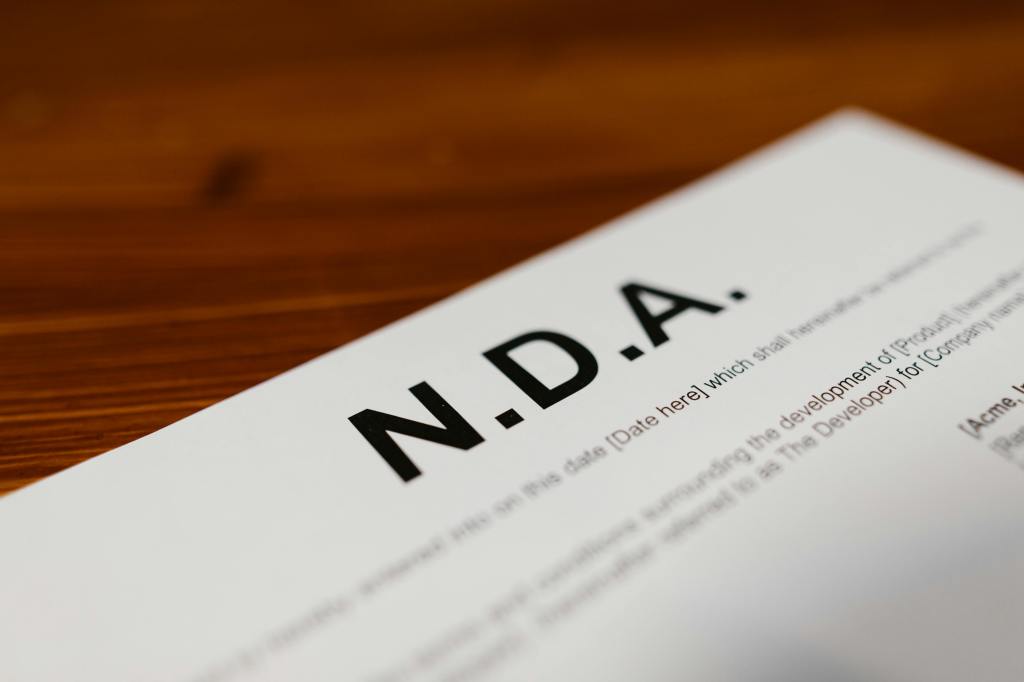
Nondisclosure agreements are confidentiality agreements between parties that prohibit the other party from disclosing information the parties consider confidential.7 Like any other contract, nondisclosure agreements must have an “offer, acceptance, consideration, and sufficient specification of essential terms.”8 The enforceability of a nondisclosure agreement depends on how well it is drafted, as there are limitations to confidentiality agreements.9 These limitations include: “the agreement can only be enforced against the parties who are bound by it,” nondisclosure agreements are “only as effective as a court says it is,” and the information at issue must be confidential.10
In determining the validity of a nondisclosure agreement, courts will pay special attention to the purpose of the agreement and the specific information the enforcing party seeks to protect.11 In defining confidential information, the drafters of the nondisclosure agreement have three approaches they can choose from: “(1) providing a general description; (2) providing a specific description; and (3) expressly marking the confidential information.”12 In the instances where courts have found nondisclosure agreements to be unenforceable, it was because the information the agreement sought to protect did not constitute a trade secret or confidential relationship between the parties,13 it lacked reasonable time limitations,14 it was overly broad in scope,15 it lacked adequate consideration,16 or it concealed a crime.17
In two of the examples given above of celebrities offering large sums of money for silence, the party being asked to sign the nondisclosure agreement had accusations of abuse18–begging the question of whether nondisclosure agreements that seek to cover up emotional abuse are enforceable. Most states have not defined emotional abuse, making it so that it does not fall into a strict statutorily defined crime.19 Other states, like Minnesota, Nevada, South Dakota, Tennessee, and Texas, have defined emotional or mental abuse only for cases of child abuse.20 Without a statutory definition, courts cannot find nondisclosure agreements unenforceable unless the agreement is against public policy or falls into one of the other categories where courts have found them to be unenforceable.21
In determining whether the agreement is against public policy, the court will decide whether “the interest in its enforcement is clearly outweighed in the circumstances by a public policy against the enforcement” of the agreement.22 The New Jersey Supreme Court has held that nondisclosure provisions that conceal claims of discrimination, retaliation, or harassment are against public policy.23 The court based its decision on New Jersey’s Law Against Discrimination(LAD), which aims to remove barriers to reporting inequalities without restriction.24 The court focused on LAD’s operative terms, asking “whether a provision in . . . [a nondisclosure agreement] ‘has the purpose or effect of concealing the details relating to a claim of discrimination, retaliation, or harassment.’”25 “If it does, the agreement is ‘against public policy and unenforceable.’”26
Other states have also attempted to use public policy as a shield against nondisclosure agreements. Minnesota has a statute in effect that prohibits the use of nondisclosure agreements that restrict victims of sexual misconduct from discussing their experiences, but only in cases of campus sexual misconduct.27 The Alaska Supreme Court held that agreements barring individuals from presenting evidence in domestic violence proceedings or reporting future criminal behavior are unenforceable because they conflict with public policy.28 Court decisions regarding emotional abuse, however, seem to be buried.
Despite Brianna LaPaglia not signing the nondisclosure agreement, we can apply the framework above to determine whether the agreement would have been enforceable had she signed on the dotted line. While the terms of Zach Bryan’s nondisclosure agreement are not public, LaPaglia’s claims of emotional abuse could have made the nondisclosure agreement unenforceable if the purpose of the agreement was to conceal his emotional abuse. In this case, Bryan’s attorneys most likely drafted the nondisclosure agreement to generally define any instances that could have been interpreted as emotional abuse. In Oklahoma (the nondisclosure agreement’s potential jurisdiction due to Zach Bryan being domiciled there29), emotional abuse is not defined statutorily–making public policy the only option for finding the nondisclosure agreement unenforceable. However, that brings us right back to the question of whether the dangers of concealing emotional abuse are against public policy.
Unfortunately, public policy is “merely a contractual shield . . . and can only be used by those internal to the contractual relationship.”30 Public policy would not prohibit Zach Bryan’s payment for Brianna LaPaglia’s silence; instead, public policy says that only executory contracts for silence cannot be enforced because the parties still have performance remaining.31 Until more states begin to recognize emotional abuse as a crime, not just an underlying crime, individuals will continue to be able to use nondisclosure agreements to silence their victims. While celebrities continue to use nondisclosure agreements to shield themselves, a more extensive conversation needs to be had about hush money, victims’ rights, and the power imbalances that fuel it all.
*Stokli Ashcraft, J.D. Candidate, University of St. Thomas School of Law Class of 2026 (Associate Editor).
- Conor Murray, Zach Bryan And Brianna LaPaglia Breakup, Explained: Dave Portnoy Releases ‘Country Diddy’ Diss Track,Forbes (Nov. 11, 2024, 11:11 AM), https://www.forbes.com/sites/conormurray/2024/11/11/zach-bryan-and-brianna-lapaglia-breakup-explained-dave-portnoy-releases-country-diddy-diss-track/ [https://perma.cc/4DZW-8PUY]. ↩︎
- BFFs: Josh Richards & Bri Chickenfry, Brianna Chickenfry Talks Zach Bryan Relationship & Breakup – BFFs EP. 198, YouTube, at 1:40-2:09 (Nov. 7, 2024), https://www.youtube.com/watch?v=UUHBGPE5nPA [https://perma.cc/96CB-2F7M]. ↩︎
- Charisma Madarang, Brianna Chickenfry Accuses Zach Bryan of Emotional Abuse, Asking Her to Sign $12 Million NDA, Rolling Stone (Nov. 7, 2024), https://www.rollingstone.com/music/music-news/zach-bryan-brianna-chickenfry-emotional-abuse-sign-nda-1235157592/ [https://perma.cc/6D5P-EZAG]. ↩︎
- Menaka N. Fernando & Eliana J. Theodorou, A Forced Reckoning With NDA’s, Outten & Golden (Oct. 23, 2024), https://www.outtengolden.com/insights/media/blogs/a-forced-reckoning-with-ndas/ [ttps://perma.cc/74E9-XLWG]. ↩︎
- Vanessa Romo, Stormy Daniels Files Suit, Claims NDA Invalid Because Trump Didn’t Sign At The XXX, NPR (Mar. 7, 2018, 10:17 AM ET), https://www.npr.org/sections/thetwo-way/2018/03/07/591431710/stormy-daniels-files-suit-claims-nda-invalid-because-trump-didnt-sign-at-the-xxx [https://perma.cc/M3TR-Z2HE]. ↩︎
- Tommy McArdle, Angelina Jolie Accuses Brad Pitt of Trying to Force Her to Sign NDA to ‘Silence’ Her Allegations of Abuse, People (Aug. 2, 2024, 04:39 PM EDT), https://people.com/angelina-jolie-brad-pitt-nda-alleged-abuse-8689562 [https://perma.cc/KG2P-MW7G]. ↩︎
- Rebecca K. Myers, Confidentiality, Nondisclosure and Secrecy Agreements, LexisNexis (Dec. 1, 2015), https://www.lexisnexis.com/community/insights/legal/practical-guidance-journal/b/pa/posts/confidentiality-nondisclosure-and-secrecy-agreements?srsltid=AfmBOooQ7vBAO9uHVydQ3rCaOC7Cj38HV7k-cm9OUY8H-naTV3qFLc9S [https://perma.cc/39R3-GRDY]. ↩︎
- Jericho All-Weather Opportunity Fund, LP v. Pier Seventeen Marina & Yacht Club, 207 So. 3d 938, 941 (Fla. Dist. Ct. App. 2016). ↩︎
- Myers, supra note 7. ↩︎
- Myers, supra note 7. ↩︎
- David T. Martin, LexisNexis Practice Guide: Connecticut ContractLitigation, § 15.03 (2025). ↩︎
- Myers, supra note 7. ↩︎
- Raven Indust. v. Lee, 783 N.W.2d 844, 849 (S.D. 2010). ↩︎
- See Howard Schultz & Assocs., Inc. v. Broniec, 236 S.E.2d 265 (Ga. 1977). ↩︎
- See Fay v. Total Quality Logistics, LLC, 799 S.E.2d 318 (S.C. Ct. App. 2017). ↩︎
- See Schimenti Constr. Co., LLC v. Schimenti, 288 A.3d 1038 (Conn. App. Ct. 2023). ↩︎
- Ventura v. Cincinnati Enquirer, 396 F.3d 784, 791 (6th Cir. 2005). ↩︎
- Madarang, supra note 3; McArdle, supra note 6. ↩︎
- State v. Moran, 297 S.W.3d 100, 103 (Mo. Ct. App. 2009). ↩︎
- Minn. Stat. § 260C.007 subd. 15 (2024); Nev. Rev. Stat. § 432B.070 (2024); S.D. Codified Laws § 26-8A-2 (2024); Tenn. Code Ann. § 37-1-602 (2023); 5 Tex. Admin. Code § 261.001 (2023). ↩︎
- Restatement (Second) of Contracts § 178 (Am. L. Inst. 1981). ↩︎
- Id. ↩︎
- See Savage v. Tp. of Neptune, 313 A.3d 65 (N.J. 2024). ↩︎
- Id. at 68. ↩︎
- Id. at 73. ↩︎
- Id. ↩︎
- Minn. Stat. § 135A.15 (2024). ↩︎
- Lana C. v. Cameron P., 108 P.3d 896, 902 (Alaska 2005). ↩︎
- Zach Bryan, https://www.zachbryan.com/about-zach [https://perma.cc/YAE5-WE34] (last visited Mar. 30, 2025). ↩︎
- David A. Hoffman & Erik Lampmann, Hushing Contracts, 97 Wash. U. L. Rev. 165, 200 (2019). ↩︎
- Id. at 201. ↩︎
 University of St. Thomas Law Journal
Leave a comment