Kate Gaulke*
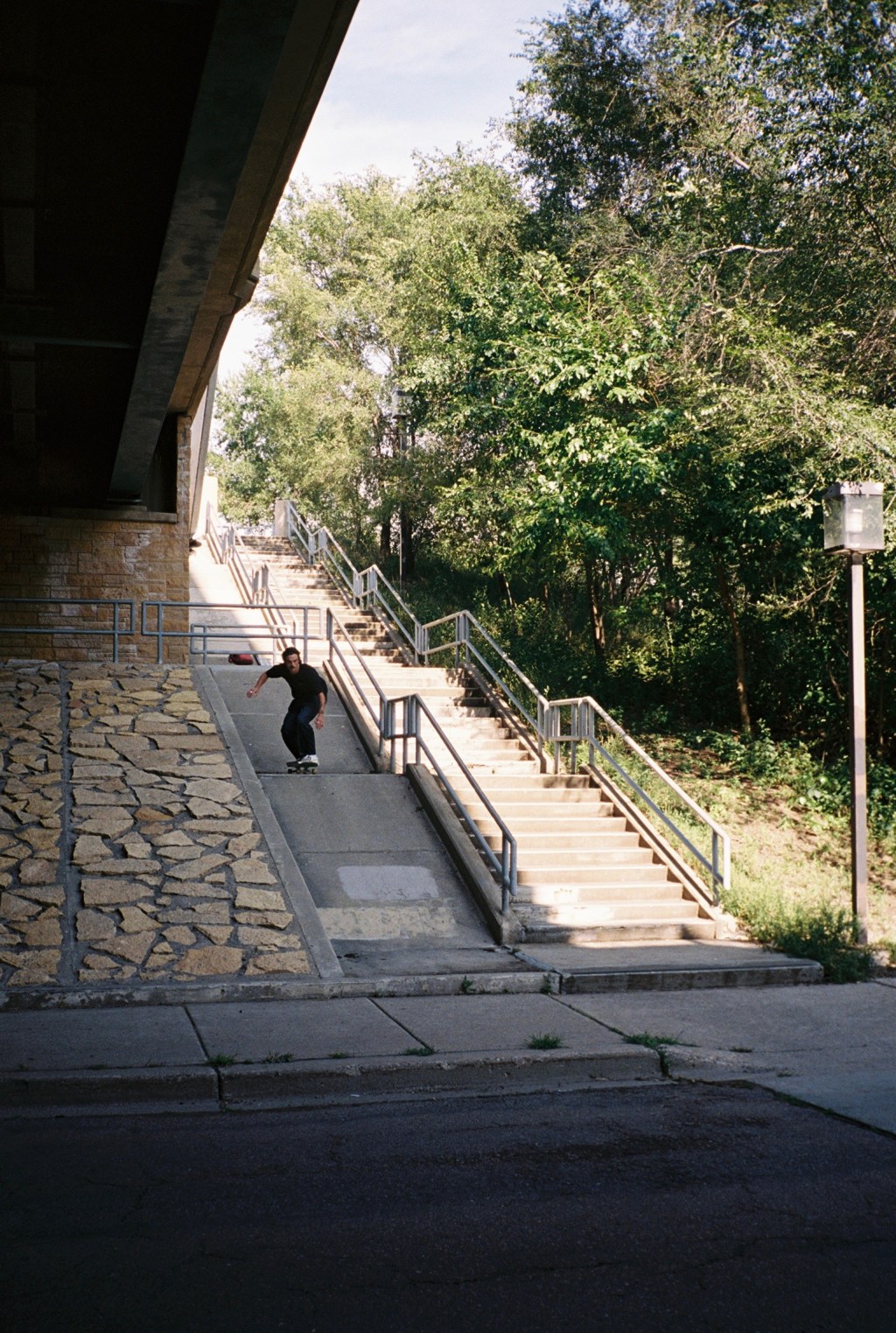
Imagine walking through downtown Minneapolis. As you cross the Hennepin Avenue Bridge toward Nicollet Island, the iconic Grain Belt Beer sign glowing overhead, you pass an unremarkable slab of concrete—cracked, rough, and disregarded by nearly everyone who walks by. But to a skateboarder, it carries a different meaning: that slab of concrete functions as a site for practice, experimentation, and skill. What looks like dead space to some becomes a playground of endless possibility to those in the skate community. That is, until the moment is cut short by a security guard or police officer writing you a citation for trespassing, property damage, or threats of criminal prosecution.1
The popular motto “Skateboarding Is Not a Crime” has become one of the most recognizable expressions in skateboarding history.2 The slogan emerged from the longstanding criminalization of skateboarding, despite the reality that “[a]ll skateboarders ever wanted was to have fun and develop their skills and style where they lived.”3
From Prohibition to Olympic Recognition: The Legal Evolution of Skateboarding
Skateboarding’s earliest known origins date back to the 1950s in California, when surfers, looking for an alternative during calm conditions, experimented with attaching roller skate wheels to wooden boards.4 Soon after the skate industry rapidly expanded in the 1960s, it almost immediately began to face resistance from policymakers, parents, and older generations concerned about injury risks, noisiness of boards striking concrete, and the sport’s emerging subculture.5 Many critics argued that “the skateboarding culture represents a youth activity that embraces anti-establishment values in opposition to middle class norms and values inherent in traditional team sports.”6 This opposition contributed to a broader perception of skaters as “rebels” or “social deviants,” often resulting in their formal exclusion from public spaces through bans, restrictions, anti-skateboarding ordinances, and, in some cases, even nationwide prohibitions.7 To assist in the enforcement of restrictive regulations, many cities implemented “anti-skate architecture” including demarcation studs, skate stoppers, and other deliberately designed obstacles to render the area unusable for skating.8 Despite these measures, skaters continued to gravitate toward urban streets for a more dynamic and unpredictable environment than a traditional skatepark has to offer.9
While an increasing number of municipalities attempted to restrict skating, broader societal attitudes began to evolve in the opposite direction.10 A key turning point was when skateboarding gained widespread recognition as a legitimate sport: first with its debut at the 2014 Nanjing Youth Olympic Games and, even more significantly, its inclusion in the 2020 Tokyo Olympics.11 The Tokyo Olympic sport of skateboarding featured two distinct disciplines: “street” skating and “park” skating.12 The park category involves riding in bowl or pool-like structures that allow skateboarders to generate speed through “pumping”13 rather than pushing, while street skateboarding incorporates elements that mimic urban environments, such as ledges, stairs, and handrails.14 Despite skateboarding’s recognition on the Olympic stage, a practical dilemma remains: how are skateboarders expected to train for a discipline rooted in real urban environments, particularly street skating, when cities prohibit skating in those very spaces and many lack sufficient, high-quality skateparks to serve as viable alternatives?15 This tension highlights a fundamental contradiction: skateboarding is celebrated on a global stage for its connection to urban environments, yet locally restricted in the same spaces that make the sport possible.
Local Control and the Regulation of Skateboarding in Minnesota
Minnesota law does not specifically outlaw skateboarding at the state level, leaving regulation largely to local governments.16 Unlike broader statutory law, municipal regulations are often shaped by localized interests, including business owners and property stakeholders, who influence how public space is used.17 These ordinances frequently rely on “nuisance” justifications—sometimes framed in terms of personal safety—but one could argue that such rationales often function as a pretext for a broader model of urban governance that prioritizes order and commercial appeal over informal or recreational uses of space.18 For example, in Minneapolis, city ordinances sharply restrict where skateboarding can occur.19 Skateboarding is permitted on public streets and sidewalks but only when conducted in a “prudent and careful manner” with “regard for safety of the operator” it is expressly prohibited on Nicollet Mall and in “any public plaza-like area[s].”20
Similarly, in the city of Anoka, Minnesota, a city ordinance significantly restricts skateboarding, including express prohibitions in designated no-skating zones, on private property without permission, on public streets and sidewalks after dark, on city-owned parking facilities, and on roads with speed limits exceeding 30 mph, as well as bans on “reckless or negligent” operation, and more.21 A violation of these restrictions constitutes a petty misdemeanor.22 In contrast, bicycle regulations in the same jurisdiction are largely limited to safety-based requirements like compliance with traffic laws, proper lighting at night, and restrictions on sidewalk riding in business districts—rather than broad, location-based prohibitions on use.23
It is no secret that skateboarding presents a risk of injury, not only to the rider, but also to those nearby.24 Cities therefore have a legitimate policy interest in limiting injuries to the public and reducing potential liability exposure. However, similar, if not greater, risks arise from bicycling on public roads.25 Yet bicycles, as a mode of transportation, are not subject to the same level of restriction as skateboarding.26 Although cyclists often travel at speeds approaching those of vehicles—and with no universal legal requirement to wear helmets—skateboarders should also be permitted to use public streets without fear of criminal penalties. While local-level advocacy may help loosen existing restrictions, the continued growth of skateboarding (particularly following its recognition as an Olympic sport) indicates that cities may begin to adopt more inclusive approaches to public space for skateboarders.
*Kate Gaulke, J.D. Candidate, University of St. Thomas School of Law, Class of 2026 (Senior Editor & Board Member).
- See Jono Coote, Kickout Stories, Sidewalk (Nov. 4, 2015), https://sidewalkmag.com/skateboard-news/kickout-stories.html [https://perma.cc/6SEV-DR7Y] (compiling humorous anecdotes from professional skateboarders about being removed from skate spots). ↩︎
- Luis MP, Skateboarding Is Not a Crime: The Original of the Slogan, Surfer Today, https://www.surfertoday.com/skateboarding/skateboarding-is-not-a-crime-the-origin-of-the-slogan [https://perma.cc/T4M7-NX5D] (last visited Apr. 3, 2024). ↩︎
- Id. ↩︎
- History of Skateboarding, Olympic Games, https://www.olympics.com/e n/sports/skateboarding/ [https://perma.cc/J9ZG-66E3] (last visited Apr. 3, 2024). ↩︎
- Linda Moore, An Ethnographic Study of the Skateboarding Culture, 24 Sport J. (2009); see also Skateboard: Culture, Lifestyle Community & Art!, The Supply Network (Apr. 25, 2023), https://www.thesupplynetwor k.co.uk/blogs/global-product-news/skateboard-culture-and-lifestyle?srsltid=AfmBOopCfgb4OlBaEltivWcM31pqGZGeqv-d-Wx51Mdz4180 u44_FMsz [https://perma.cc/YF6Z-9HNN] (explaining that, despite stigma from older generations, “[s]kateboard culture is characterized by a DIY spirit, a love of music and art, and a deep sense of community.”). ↩︎
- Moore, supra note 5. ↩︎
- Moore, supra note 5; see also Tommy Langseth & Nils Asle Bergsgard, Pavement Policies: Unraveling the Norwegian Ban on Skateboarding, 6 Frontiers Sports & Active Living 1488825 (2025) (explaining that Norway’s ban on skateboarding was based on risk management, countercultural concerns, and bureaucratic categorization, institutional dynamics, and regulatory processes within the state’s product control framework). ↩︎
- The Use of Anti-Skate Architecture in Urban Design, Studmarc, https://www.studmarc.com/the-use-of-anti-skate-architecture-in-urban-design/?srsltid=AfmBOoqLYpexavITAfTR8PPppfysbObY uwMikLnDdV_O-i5BUXRuegp9 [https://perma.cc/R9WP-UGUN] (last visited Apr. 3, 2026) (“It’s important to strike a balance that allows for the safe and responsible practice of skateboarding while also protecting public property and respecting the needs of the community.”). ↩︎
- Id. ↩︎
- See generally Skateboarding Joins Permanent Olympic Event Schedule From LA 2028, World Skate (Feb. 4, 2022), https://www.worldskate.org/new s/44-discipline/skateboarding/3410-skateboarding-joins-permanent-olympic-event-schedule-from-la-2028.html [https://perma.cc/BE47-D5DZ] (“Skateboarding’s investiture into official Olympic event status leads on from the huge success of last summer’s Tokyo Olympics and the excitement already surrounding Paris 2024.”). ↩︎
- History of Skateboarding, supra note 4. ↩︎
- History of Skateboarding, supra note 4. ↩︎
- See The Pump, School of Skate, https://www.schoolofskate.co.uk/portfolio-item/learn-pump-skateboard-ramp/ [https://perma.cc/K5JH-RLPU] (last visited Apr. 3, 2026) (explaining that “pumping” is a technique for generating speed on a skateboard by shifting one’s weight and center of gravity in sync with the transition, leaning back when ascending and forward when descending to maintain momentum without pushing). ↩︎
- History of Skateboarding, supra note 4. ↩︎
- See Greg Rosalsky, This Skateboarding Economist Suggests We Need More Skateparks and Less Capitalism, NPR: Planet Money Newsletter (Jan. 14, 2025, at 06:30 ET), https://www.npr.org/sections/planet-money /2025/01/14/g-s1-42171/this-skateboarding-economist-suggests-we-need-more-skateparks-and-less-capitalism [https://perma.cc/QCC4-JAD8]. ↩︎
- But see Minn. Stat. § 169.222(3) (2025) (noting that Minnesota statutes reference “skateboards” only in the context of prohibiting riders from attaching themselves to vehicles on a roadway). ↩︎
- Brian Glenney, Skateboard Crime and the Pirating of Urban Space, 21(2) Crime Media Culture 211, 214 (2025). ↩︎
- Id. ↩︎
- Minneapolis, Minn., Code of Ordinances § 427.300 (2026). ↩︎
- Id. ↩︎
- Anoka, Minn., City Code § 66-115 (2026). ↩︎
- Id. ↩︎
- Anoka, MN, Laws You Should Know, https://www.anokamn.gov/290/Laws-You-Should-Know [https://perma.cc/X5RS-YMDU] (last visited Apr. 30, 2026) (providing an overview of various local ordinances and public safety rules residents should be aware of, including regulations on conduct, noise, and use of public spaces). ↩︎
- See generally Micah Dorfner, Play It Safe on Your Bike, Skateboard or In-Line Skates, Mayo Clinic (May 21, 2015), https://newsnetwork.mayoclin ic.org/discussion/play-it-safe-on-your-bike-skateboard-or-in-line-skates/ [https://perma.cc/2QQJ-2G9U] (citing that “[n]ext to motor-vehicle injuries, bicycles injure more children [than] any other consumer product . . . .”). ↩︎
- Id. ↩︎
- See generally Anoka, MN, supra note 23 (noting that, unlike skateboards, bicycles are not subject to the same specific restrictions under local ordinances). ↩︎
 University of St. Thomas Law Journal
Leave a comment